Why Is Marcel Duchamp Considered the Grandfather of Street Art

All things appear to us in the shape of forms. Even in metaphysics ideas are expressed by forms, well then think how cool it would exist to think of painting without the imagery of forms. A figure, an object, a circle, are forms; they affects us more than or less intensely.
Pablo Ruiz Picasso (25 Oct 1881 – 8 Apr 1973) was a Spanish artist who lived and worked in Paris for many years. Around 1906–1908 together with Georges Braque Picasso initiated cubism, based on a potent inspiration of Paul Cézanne's work.
Quotes [edit]

cartoon past Ramon Casas: Pablo Picasso in Kingdom of spain, c. 1900

portrait of Pablo Picasso, painted by Modigliani in 1915


Picasso, 1909: 'Head of a Woman (Fernande)', sculpture

photo of Picasso, sitting in front of his painting 'The Aficionado', in Summer of 1912
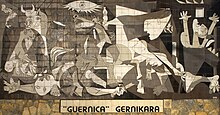
Picasso, 1937: 'Landscape after his painting Guernica, he fabricated in 1937; - quote of Picasso, 1937: '..this bull is a bull and this equus caballus is a equus caballus.. .I make the painting for the painting. I pigment the objects for what they are'

Picasso, 1954 - 1970: 'Sylvette', sculpture in Rotterdam; - later quote of his model 'Sylvette' in 1954: 'I was terrified he'd ask me to pose in the nude just he was very sensitive to this. He saw I didn't like myself and wanted to know why.. [she did not tell Picasso] That's why he painted me like that.. ..I didn't speak much

Picasso, 1965: 'Figure découpée', sculpture in Vondelpark, Amsterdam

Picasso, c. 1960s: Marble balderdash's head, relief in marble

Picasso, 1965-67: 'Chicago Picasso', metal sculpture; - Quote of Picasso, 1943: 'Art is not fabricated to decorate rooms. Information technology is an offensive and defensive weapon against the enemy'
1920s [edit]
- Among the several sins that I have been accused of committing, none is more than simulated than the 1 that I have, as the principal objective in my work, the spirit of enquiry. When I paint my object is to show what I have found and not what I am looking for. In art intentions are not sufficient and, as nosotros say in Spanish, love must be proved by facts and not by reasons... [Paris 1923].
- As quoted in Futurism, ed. Didier Ottinger; Centre Pompidou / 5 Continents Editions, Milan, 2008, p. 311
- When I hear people speak of the evolution of an artist, it seems to me that they are considering him standing between two mirrors that face each other and reproduce his image an infinite number of times, and that they contemplate the successive images of one mirror as his past, and the images of the other mirror as his hereafter, while his real image is taken equally his present. They do not consider that they all are the same images in different planes... [Paris 1923].
- Every bit quoted in Futurism, ed. Didier Ottinger; Centre Pompidou / 5 Continents Editions, Milan, 2008, p. 311
- They speak of naturalism in opposition to modern painting. I would like to know if anyone has ever seen a natural piece of work of art. Nature and art, being two different things, cannot be the aforementioned matter. Through art we express our conception of what nature is not. Velasquez left us his idea of the people of his epoch. Undoubtedly they were different from what he painted them, merely nosotros cannot conceive a Philip IV in whatsoever other way than the 1 Velasquez painted... [Paris 1923].
- As quoted in Futurism, ed. Didier Ottinger; Eye Pompidou / five Continents Editions, Milan, 2008, p. 312
"Picasso Speaks" (1923) [edit]
- "Picasso Speaks" in The Arts, vol. 3, ed. Marius de Zayas, New York, May 1923. pp. 315-329; Reprinted in Alfred Barr: Picasso, New York 1946, pp. 270–1
- I can hardly understand the importance given to the give-and-take research in connection with mod painting. In my stance to search means zero in painting. To find is the matter. Nobody is interested in following a man who, with his eyes fixed on the basis, spends his life looking for the purse that fortune should put in his path. The ane who finds something no matter what it might be, even if his intention were not to search for it, at to the lowest degree arouses our curiosity, if non our adoration.
- p. 315
- Nosotros all know that Art is non truth. Art is a lie that makes us realize truth, at to the lowest degree the truth that is given us to understand. The artist must know the manner whereby to convince others of the truthfulness of his lies. If he but shows in his piece of work that he has searched, and re-searched, for the fashion to put over lies, he would never reach annihilation.
- p. 315.
- Cubism is no different from whatever other school of painting. The same principles and the aforementioned elements are common to all. The fact that for a long time cubism has not been understood and that even today there are people who cannot see anything in it, means null. I do not read English, and an English book is a blank to me. This does non mean that the English language language does not exist, and why should I arraign anyone merely myself if I cannot understand what I know cipher about?
- p. 319.
- Variation does not hateful evolution. If an artist varies his mode of expression this only means that he has changed his mode of thinking, and in irresolute, it might be for the better or it might be for the worse.
- p. 391.
- Many think that Cubism is an fine art of transition, an experiment which is to bring ulterior results. Those who think that way accept not understood information technology. Cubism is non either a seed or a foetus, merely an art dealing primarily with forms, and when a form is realized it is there to live its own life. A mineral substance, having geometric formation, is not made and so for transitory purposes, it is to remain what it is and will always take its own course.
- p. 323.
'The Arts', New York, May 1923 [edit]
Every bit quoted past Marius de Zayas, in 'The Arts', New York, May 1923
- Mathematics, trigonometry, chemistry, psychoanalysis, music, and what not have been related to cubism to requite it an easier estimation. All this has been pure literature, not to say nonsense, which brought bad results, blinding people with theories. Cubism has kept itself within the limits and limitations of painting, never pretending to go beyond it.
- The thought of inquiry has often made painting go astray, and fabricated the artist lose himself in mental lucubrations. Perhaps this has been the principal mistake of modern art. The spirit of research has poisoned those who have not fully understood all the positive and conclusive elements in modernistic art and has made them endeavour to paint the invisible and, therefore, the unpaintable.
- And from the point of view of fine art at that place are no concrete or abstract forms, but only forms which are more or less disarming lies. That those lies are necessary to our mental selves is beyond any doubt, as information technology is through them that we grade our aesthetic signal of view of life. (Paris 1923)
- I also ofttimes hear the word 'evolution'. Repeatedly I am asked to explain how my painting evolved. To me at that place is no past or future in my art. If a work of art cannot live always in the present it must not be considered at all. The fine art of the Greeks, of the Egyptians, of the corking painters who lived in other times, is not an art of the past; perhaps it is more alive today than it always was. Art does not evolve past itself, the ideas of people change and with them their mode of expression. (Paris 1923)
- I practise not believe I accept used radically dissimilar elements in the different manners I have used in my paintings. If the subjects I have wanted to express have suggested unlike ways of expression, I have never hesitated to adopt them. I take never fabricated trials nor experiments. Whenever I had something to say I take said it in the fashion in which I accept felt it ought to exist said. Dissimilar motives inevitably require different methods of expression. (Paris 1923)
1930s [edit]
- The smell of opium is the least stupid smell in the world.
- Quote, attributed to Picasso in: Jean Cocteau (1932), Opium: The Diary of an Addict. p. 63
- When I went to Trocadéro it was icky. ...The scent. I was all alone. I wanted to get away. But... I stayed. ...I understood something very of import... was happening to me... The masks... were magical things. ...The Negroes' sculptures were intercessors... Confronting everything; against unknown threatening spirits. I kept looking at the fetishes. I understood: I likewise am against everything. I too remember everything is unknown, is the enemy! Everything! ...I understood ...the purpose ...all the fetishes were ...weapons. To help people stop being dominated past spirits, to become independent. Tools. If we give form to the spirits, nosotros become independent of them. The spirits, the unconscious... emotion, it's the same matter. I understood why I was a painter. All alone in that awful museum, with the masks, the redskin dolls, the dusty mannequins. Les Demoiselles d'Avignon must have come to me that twenty-four hour period, but not at all because of the forms: but because it was my first canvass of exorcism—yes, absolutely!
- Interview with André Malraux (1937) describing a 1907 experience in the Palais du Trocadéro ethnographic museum, as quoted past Jean-Louis Paudrat, "From Africa", Primitivism and 20th Century Art: Affinity of the Tribal and the Mod (1984) ed., William Ruben, Vol. 1, p. 141; and "Discovery of African Art 1906-7", Primitivism and Twentieth-Century Art: A Documentary History (2003) ed. Jack Flam, Miriam Deutch, p.34; and in Matisse and Picasso: The Story of Their Rivalry and Their Friendship (2003) by Jack Flam, p. 34.
- Information technology isn't up to the painter to define the symbols. Otherwise it would be better if he wrote them out in and then many words! The public who expect at the moving picture must interpret the symbols every bit they sympathize them.
- Picasso (1937), quote in: William Rowlandson (2007), Reading Lezama'south Paradiso. p. 115.
- Reply past Picasso when he was asked to explain the symbolism in the Guernica.
- ...this bull is a balderdash and this equus caballus is a horse... If you give a meaning to certain things in my paintings it may be very true, only it is non my idea to give this meaning. What ideas and conclusions you have got I obtained too, but instinctively, unconsciously. I brand the painting for the painting. I paint the objects for what they are.
- Paul Jones (2011), The Sociology of Architecture: Amalgam Identities. p. 47.
- Other explanation past Picasso of the Guernica.
- But there is one very odd matter - to observe that basically a pic doesn't change, that the first 'vision' remains almost intact, in spite of appearances. I often ponder on a calorie-free and a nighttime when I have put them into a painting; I try hard to interruption them upward by interpolating a color that will create a unlike event. When the work is photographed, I note that what I put in to right my first vision has disappeared, and that, subsequently all, the photographic paradigm corresponds with my kickoff vision before the transformation I insisted on. [Boisgeloup, winter 1934]
- Futurism, ed. Didier Ottinger; Centre Pompidou / 5 Continents Editions, Milan, 2008, p. 313
"Conversations avec Picasso," 1934–35 [edit]
- Interview with Christian Zervos in: "Conversation avec Picasso," in Cahiers d'Fine art, Vol X, vii-10, (1935), p. 173-178. Translated in: Alfred H. Barr, Jr. Picasso: 50 Years of His Art. 1946, and republished in: Herschel Browning Flake (1968), Theories of Mod Art: A Source Book past Artists and Critics. (1968), p. 266-273; also quoted in: Richard Friedenthal, Letters of the Nifty Artists – From Blake to Pollock -, Thames and Hudson, London, 1963. (transl. Daphne Woodward).
- It is my misfortune - and probably my delight - to employ things as my passions tell me. What a miserable fate for a painter who adores blondes to take to cease himself putting them into a moving picture because they don't become with the basket of fruit!
- Herschel Browning Chip (1968, p. 267).
- (another and longer version:) What a pitiful fate for a painter who loves blondes, but who refrains from putting them in his picture because they don't go with the handbasket of fruit! What misery for a painter who hates apples to be obliged to use them all the fourth dimension because they go with the textile! I put everything I honey in my paintings. So much the worse for the things, they have just to suit themselves with 1 another
- Richard Friendenthal (1963, p. 256).
- In the old days pictures went frontward toward completion past stages. Every day brought something new. A picture used to be a sum of additions. In my case a moving picture is a sum of destructions. I practise a picture — so I destroy it. In the stop though, zippo is lost: the red I took away from i place turns up somewhere else
- Herschel Browning Bit (1968, p. 267)
- Other translation:
Formerly pictures used to move towards completion in progressive stages. Each twenty-four hours would bring something new. A picture was a sum of additions. With me, motion picture is a sum of destructions. I practise a picture, then I destroy it. Just in the long run nothing is lost; the red that I took abroad from ane place turns up somewhere else.- Richard Friedenthal (1968, p. 256); Also quoted in: John Bowker (1988), Is anybody out there?: religions and belief in God in the contemporary world. p. 57.
- I would like to manage to prevent people from ever seeing how a picture show of mine has been done. What tin can information technology possibly affair? What I desire is that the only matter emanating from my pictures should be emotion. [Boisgeloup, winter 1934].
- Richard Friendenthal (1963, p. 256).
- Information technology would be very curious to record by means of photographs, not the stage of the pic, but its metamorphoses. Peradventure ane would perceive the path taken by the listen in guild to put its dreams into a physical grade. Simply what is really very curious is to observe that fundamentally the moving-picture show does non alter, that despite appearances the initial vision remains almost intact (Boisgeloup, winter 1934).
- Richard Friedenthal, (1963, p. 256).
- Abstract art is simply painting. What most drama?
At that place is no abstract art. You lot ever get-go with something. Afterwards you can remove all traces of reality.- Herschel Browning Chip (1968, p. 270).
- Other translation:
Abstract art is merely painting. And what's so dramatic about that? There is no abstract art. One must ever brainstorm with something. Afterwards 1 can remove all semblance of reality.- Richard Friedenthal (1968, p. 256-7).
- Longer version:
Abstract art is only painting. And what's so dramatic about that? There is no abstruse art. I must always brainstorm with something. Afterwards one tin can remove all semblance of reality; in that location is no longer any danger as the idea of the object has left an indelible banner. It is the object which aroused the artist, stimulated his ideas and ready of his emotions. These ideas and emotions volition exist imprisoned in his piece of work for good.. .Whether he wants it or not, man is the musical instrument of nature; she imposes on him character and appearance. In my paintings of Dinard, equally in my paintings of Purville, I take given expression to more than or less the same vision.. .. You cannot go against nature. She is stronger than the strongest of men. Nosotros can permit ourselves some liberties, simply in details only (Boisgeloup, wintertime 1934).- As quoted in Futurism, ed. Didier Ottinger; Centre Pompidou / v Continents Editions, Milan, 2008, p. 313
- Longer version:
- Richard Friedenthal (1968, p. 256-7).
- Neither is there figurative and non-figurative art. All things appear to us in the shape of forms. Even in metaphysics ideas are expressed past forms, well then think how absurd it would be to recall of painting without the imagery of forms. A effigy, an object, a circle, are forms; they affects us more or less intensely. [Boisgeloup, winter 1934].
- Richard Friedenthal, (1963, pp. 257-258).
- Do you think it interests me that this painting represents two figures? These two figures existed, they be no more. The sight of them gave me an initial emotion, little by little their existent presence grew indistinct they became a fiction for me, then they disappeared, or rather, were turned into issues of all kinds. For me they are no longer two figures but shapes and colours, don't misunderstand me, shapes and colours, though, that sum up the idea of the ii figures and preserve the vibration of their [Boisgeloup, winter 1934]
- Richard Friedenthal, (1963, p. 258)
- Information technology is not what the creative person does that counts. Merely what he is. Cézanne would never have interested me if he had lived and thought similar Jaques-Emile Blanche, even if the apple he had painted had been ten times more beautiful. What interests usa is the feet of Cézanne, the teaching of Cézanne, the ache of Van Gogh, in brusk the inner drama of the man. The rest is faux. [Boisgeloup, winter 1934].
- Richard Friedenthal, (1963, p. 259)
- How can you expect a beholder to experience my flick as I experienced it? A picture comes to me a long fourth dimension beforehand; who knows how long a time beforehand, I sensed, saw, and painted it and yet the next day even I practise non understand what I have done. How tin can anyone penetrate my dreams, my instincts, my desires, my thought, which have taken a long time to manner themselves and come up to the surface, higher up all to grasp what I put there, mayhap involuntary.
- Richard Friedenthal, (1963, p. 260).
- I deal with painting every bit I deal with things, I pigment a window just equally I look out of a window. If an open window looks wrong in a moving picture, I depict the curtain and shut it, just as I would in my own room. In painting, as in life, you must human activity directly.
- Herschel Browning Chip (1968, p. 271).
- Academic preparation in beauty is a sham. We accept been deceived... The beauties of the Parthenon, Venuses, Nymphs, Narcissuses are then many lies. Art is non the application of a canon of beauty but what the instinct and the encephalon can excogitate beyond whatever canon.
- Herschel Browning Chip (1968, p. 271), quoted in Chipp (1978, 266); Equally cited in: Constance Milbrath (1998), Patterns of Artistic Development in Children, p. 257.
- When we did Cubist paintings [Picasso and Georges Braque, in their early on Cubist period in Paris], our intention was non to produce Cubist paintings just to express what was within us. No one laid down a form of activity for us, and our friends the poets [a.o. Appolinaire and Cendral] followed our endeavor intently only they never dictated it to us. [Boisgeloup, winter 1934].
- Quote of Picasso in Futurism, ed. Didier Ottinger; Centre Pompidou / five Continents Editions, Milan, 2008
- Anybody wants to sympathise painting. Why don't they try to empathise the song of the birds? Why do they love a night, a flower, everything which surrounds homo, without attempting to understand them? Whereas where painting is concerned, they desire to sympathize. Allow them understand above all that the artist works from necessity; that he, too, is a infinitesimal chemical element of the earth to whom one should ascribe no more than importance than so many things in nature which charm us simply which nosotros do not explain to ourselves. Those who attempt to explain a picture are on the wrong track most of the time. Gertrude Stein, overjoyed, told me some time ago that she had finally understood what my motion-picture show represented: three musicians. It was a still life!! [Boisgeloup, winter 1934].
- Equally quoted in Futurism, ed. Didier Ottinger; Centre Pompidou / 5 Continents Editions, Milan, 2008
- The painter goes through states of fullness and evacuation. That is the whole hush-hush of art. I get for a walk in the forest of Fontainebleau. I get 'green' indigestion. I must get rid of this sensation into a picture. Green rules it. A painter paints to unload himself of feelings and visions. People seize on painting to cover upward their nakedness. They get what they can wherever they can. In the end I don't believe they get anything at all. They've merely cutting a coat to the measure of their own ignorance. They make everything, from God to a picture, in their own image. That is why the picture-hook is the ruination of a painting. [Boisgeloup, winter 1934].
- As quoted in Futurism, ed. Didier Ottinger; Eye Pompidou / v Continents Editions, Milan, 2008
- You don't demand to show them to me [the notes of the consummate interview which Christian Zervos], editor of 'Cahiers d'Fine art' showed Picasso after their conversations at Boisgeloup: Picasso's land place then]. The essential thing in our period of weak morale is to create enthusiasm. How many people have actually read Homer? All the same the whole earth talks of him. In this manner the Homeric legend is created. A legend in this sense provokes a valuable stimulus. Enthusiasm is what we need most, we and the younger generation. [Boisgeloup, 1935]
- As quoted in Futurism, ed. Didier Ottinger; Eye Pompidou / 5 Continents Editions, Milan, 2008
1940s [edit]
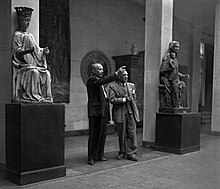
Stanisław Lorentz guides Pablo Picasso through the National Museum in Warsaw. 1948
- Well-nigh every evening [in their common early-Cubist years, in Paris], either I went to Braque's studio or Braque came to mine. Each of us had to see what the other had done during the day. We criticized each other's paintings. A canvas wasn't less both of us fear p. 311
- Art is not made to decorate rooms. It is an offensive weapon in the defence against the enemy.
- La peinture n'est pas faite pour décorer des appartements. C'est united nations instrument de guerre offensive et défensive contre l'ennemi.
- La pintura no se ha inventado para adornar las habitaciones. La pintura es un arma ofensiva, en la defensa contra el enemigo.
- Les lettres françaises (1943-03-24).
- When I was a kid my mother said to me, 'If you are a soldier, yous will become a general. If you are a monk, you will become the Pope.' Instead, I was a painter, and became Picasso.
- As quoted in Life with Picasso, by François Gilot, 1964, p. threescore
1950s [edit]
- When Matisse dies, Chagall will be the just painter left who understands what color actually is. I'm non crazy about those cocks and asses and flying violinists and all the sociology, but his canvasses are really painted, not just thrown together. Some of the final matter'south he's washed in Vence [where Matisse painted his late frescos in the chapel] convince me that there's never been anybody since Renoir who has the feeling for light that Chagall has. [Picasso is reacting to Chagall'south daughter Ida, 1952]
- Quote in a writing of Francoise Gilot; as quoted in Marc Chagall, – a Biography, by Sidney Alexander, Cassell, London, 1978, p. 440
- Les gloires, les trompettes, les palmes... et les bas-reliefs,... tout cela fait un monument.
- Translation: The glories, trumpets, palms... and low reliefs,... all that makes a monument.
- Picasso (1952). Quoted in: Michael D. Garval (2004), "A Dream of Rock": Fame, Vision, and Monumentality in Nineteenth-century French Literary Civilisation. p. 226.
- Picasso commented on the thing of the monument destruction in Paris.
- When I don't have crimson, I use blue.
- Pablo Picasso (1953); quoted in: Kilkenny (2004), Doomsday Marauders, p. 83.
- When Matisse died, he left me his Odalisques 'as a legacy', he proclaimed.
- afterward the expiry of Matisse (1954); as quoted in Matisse & Picasso, By Paul Trachtman, Smithsonian Mag, Feb 2003, p. vii
- On Baronial 2, 1914, I took Braque and Derain to the Gare d'Avignon [drafted as a soldier for World war 1.] I never saw them once more [not literally a fact, but the shut relation between Picasso and Braque ended].
- Quote in My Galleries and Painters, Daniel-Henry Kahnweiler, New York Viking Printing, 1971, p. 46
- Picasso in a talk c. 1955, with Daniel-Henry Kahnweiler
- Accidents, endeavor to change them - information technology's impossible. The adventitious reveals homo.
- Quote in Faddy, 1 Nov 1956.
- There are painters who transform the sun into a yellow spot merely there are others who with the help of their art and their intelligence transform a yellow spot into a lord's day.
- In: Sergei Eisenstein (1957), Film form [and]: The picture show sense, p. 127.
- On met très longtemps à devenir jeune.
- It takes a very long time to become immature.
- As quoted by Jean Cocteau The Manus of a Stranger (Journal d'un Inconnu). Horizon Press. 1959 [1953]. [ane]
1960s [edit]

Picasso in Dainty, France, 1961
- Fifty-fifty the signature of Kodra is a work of art.
- Repubblica, 2006[1]
- La Provincia, 2006[2]
- The artist is a receptacle for emotions derived from anywhere: from the heaven, from the world, from a piece of paper, from a passing effigy, from a spider's web. This is a spider's web. This is why one must not make a stardom between things. For them at that place are no aristocratic quarterings. One must take things where one finds them.
- Quoted in Letters of the peachy artists – from Blake to Pollock, Richard Friedenthal, Thames and Hudson, London, 1963, p. 258 (translation Daphne Woodward)
- Fifty'fine art n'est pas chaste [...], on devrait l'interdire aux ignorants innocents, ne jamais mettre en contact avec lui ceux qui y sont insuffisamment préparés. Oui, 50'art est dangereux. Ou due south'il est celibate, ce n'est pas de fifty'fine art.
- Art is never celibate. It ought to be forbidden to ignorant innocents, never allowed into contact with those not sufficiently prepared. Yes, fine art is unsafe. Where information technology is chaste, it is not art.
- Quote by Antonina Vallentin (1963 [1957]), Picasso, p. 168.
- [Speaking of computers] But they are useless. They can only give you answers.
- Every bit discussed in this entry from Quote Investigator, the origin seems to be the article "Pablo Picasso: A Composite Interview" by William Fifield which appeared in The Paris Review 32, Summer-Fall 1964, and nerveless a number of interviews Fifield had done with Picasso.
- Mutual subsequently variant: "Computers are useless. They can only give you answers." This variant seems to accept arisen in the 1980s, the earliest known advent in a book is Herman Feshbach, "Reflections on the Microprocessor Revolution: A Physicist'due south Viewpoint", in Man and Engineering (1983), ed. Bruce Thou. Adkins, where the attribution is described equally "rumoured".[2]
- Information technology'southward like God's. God is really only another artist. He invented the giraffe, the elephant, and the cat. He has no existent style. He just goes on trying other things.
- Picasso quoted in 'Fourth dimension'; quoted in: The Atlantic, Vol. 214 (1964), p. 97.
- Picasso commented on his ambiguous style, or utilise of multiple styles.
- Matisse makes a drawing, and so he makes a copy of it. He recopies it five times, ten times, always clarifying the line. He's convinced that the last, the most stripped down, is the best, the purest, the definitive one; and in fact, most of the time, it was the first. In cartoon, zip is amend than the first endeavour.
- Quote (1964); as quoted in Picasso and Visitor (trans. 1966) by Gyula Brassaï
- You take got to exist able to picture side by side everything Matisse and I were doing at that time. No one has ever looked at Matisse's painting more than advisedly than I; and no one has looked at mine more carefully than he.
- Quote past quondam Picasso (1960'southward); as quoted in 'Matisse & Picasso', Paul Trachtman, Smithsonian Magazine, February 2003, p one
- When in that location'southward annihilation to steal, I steal
- Quoted in: Thought. Vol. 17 (1965). p. 154.
- The magazine further commented:
Picasso's remark — "When there'due south annihilation to steal, I steal" — was fair alarm to the contest. In modern fine art he has been, for years, the cock-of- the-walk, (The broody hens, one supposes, are also part of that motion picture.) Merely the book is valuable, primarily, for Picasso'south observations about his ain work and the work of others.
- It means nil to me. I have no opinion about it, and I don't care.
- On the first moon landing, quoted in The New York Times (1969-07-21).
- For me, there are two kinds of women — goddesses and doormats.
- Quoted in: Briton Hadden, Henry Robinson Luce (1969), Time, Vol. 93. p. 66.
1970s [edit]
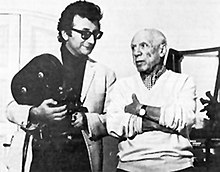
- I was thinking near Casagemas's death that started me painting in blue.
- Original: C'est en passant que Casagemas était mort que je me suis mis à piendre en bleu
- Quoted in Pierre Daix, La Vie de Peintre de Pablo Picasso, Paris: Editions du Seuil, 1977.
- Picasso explained his friend Pierre Daix (around 1965), why he started painting in blue early around 1905. Picasso had made a portrait of Carles Casagemas in 1899.
- To contradict. To show ane eye total confront and one in profile. Nature does many things the way I do, but she hides them! My painting is a serial of non-sequiturs. ...
- Quoted in: Pierre Cabanne (1977), Pablo Picasso: His Life and Times, p. 268.
- Success is unsafe. Ane begins to copy oneself and to copy oneself is more than unsafe than to copy others.
- Quoted in: The Artist, Vol. 93 (1978) p. 5.
- Potable to me. Drink to my health. Yous know I can't drinkable whatever more.
- Quoted in: Scott Slater, Alec Solomita (1980), Exits: stories of dying moments & parting words. p. 8.
- Slater & Solomita (1980) explained:
"It was a spirited dinner and Picasso a cheerful, genial host. After the meal, while pouring wine into a friend'south glass, Picasso said, Drinkable to me. Drink to my health. You know I can't drink any more. A little subsequently, about 11:30 P.M., he left his guests, saying, And now I must go back to work. He was up painting until 3:00 A.M. That morning Picasso woke at eleven:30, unable to move. By 11:40 he was dead..".
Attributed from posthumous publications [edit]
- 1970s
- I don't know where he [ Marc Chagall ] gets those images; he must have an angel in his head.
- As quoted in Marc Chagall, – a Biography, past Sidney Alexander, Cassell, London, 1978, p. 33
- 1980s
- Zip can be accomplished without solitude; I have made a kind of solitude for myself.
- Quote in "Picasso", Hans L. C. Jaffe, Thames and Hudson Ltd
- To find is the thing.
- Quote in "Picasso", Hans Fifty. C. Jaffe, Thames and Hudson Ltd
- I do not meet why and then much importance should exist attached to the idea of 'enquiry' in painting.
- Quote in "Picasso", Hans Fifty. C. Jaffe, Thames and Hudson Ltd
- I care for paintings equally I treat objects. If a window in a flick looks wrong, I close information technology and depict the curtains, just as I would do in my own room.
- Quote in "Picasso", Hans L. C. Jaffe, Thames and Hudson Ltd
- For me, art has neither past nor future. All I accept ever made was for the present.
- Quote in "Picasso", Hans Fifty. C. Jaffe, Thames and Hudson Ltd
- For a long time I limited myself to one colour — as a form of bailiwick.
- quoted in Picasso on Art (1988), ed. Dore Ashton
- quote on Picasso's 'Blue' and 'Rose' periods
- "Yous mustn't alway believe what I say", he once told me. "Questions tempt you to tell lies, especially when there is no answer."
- From Picasso, His Life and Piece of work, Sir Roland Penrose, (1981), p. 413
- I begin with an thought and then information technology becomes something else. Afterward all, what is a painter? He is a collector who gets what he likes in others past painting them himself. This is how I brainstorm and then it becomes something else.
- Quoted in: Ann Livermore (1988), Artists and Aesthetics in Spain. p. 154
- People who try to explain pictures are commonly barking upwards the wrong tree.
- Quoted in Picasso on Art (1988), ed. Dore Ashton.
- Their forms had no more influence on me than they did on Matisse. Or Derain. But for them, the masks were sculptures similar all others. When Matisse showed me his first African head, he spoke to me of Egyptian art.
- Andre Malraux cites Picasso in: Anatoliĭ Podoksik, Marina Aleksandrovna Bessonova, Pablo Picasso (1989), Picasso: The Artists Piece of work in Soviet Museums. p. 13.
- Picasso talking about his discovery of African fine art.
- 1990s
- La inspiración existe, pero tiene que encontrarte trabajando.
- Translation: Inspiration exists, just it has to find you working.
- In: Tomás R. Villasante (1994), Las ciudades hablan: identidades y movimientos sociales en seis metrópolis latinoamericanas. p. 264.
- People want to find a 'meaning' in everything and anybody. That'south the disease of our age, an age that is annihilation but applied but believes itself to exist more practical than any other historic period.
- Quoted in: Ingo F. Walther (1996), Picasso, p. 67.
- Information technology took me four years to pigment similar Raphael, just a lifetime to paint like a kid.
- Quoted in: Peter Erskine, Rick Mattingly (1998), Drum Perspective, p. 73.
- Alternative forms:
- "At eight, I was Raphael", he used to say. "It took me a whole lifetime to paint similar a child"
- From Picasso, my grandfather, Marina Picasso (2001).
- "At eight, I was Raphael", he used to say. "It took me a whole lifetime to paint similar a child"
Misattributed [edit]
- I am always doing that which I can not do, in order that I may learn how to practice it.
- Attributed in Civilization'southward Quotations : Life'south Ideal (2002) past Richard Alan Krieger, p. 132, and many places on the internet, this was actually stated past Vincent van Gogh in a letter to Anthon van Rappard (xviii August 1885)[three], also rendered "I keep on making what I tin't do yet in guild to learn to be able to exercise information technology."
- The urge to destroy is also a artistic urge.
- Attributed by Banksy on Instagram (October 6, 2018): "The urge to destroy is likewise a artistic urge" - Picasso. This was actually written by anarchist philosopher Mikhail Bakunin in his essay "Reaction in Germany," in 1842.[iii] [4]
Disputed [edit]
- Every child is an artist. The problem is how to remain an artist once he grows up.
- Quote attributed to Picasso in TIME, Oct 4, 1976, Modern Living: Ozmosis in Fundamental Park [4] [5]
- Good artists copy, great artists steal.
- Compare: "Young poets imitate; mature poets steal." T. S. Eliot, in Philip Massinger, in The Sacred Woods (1920)
- Yo no busco, yo encuentro.
- I do not seek, I find.
- Quoted in Graham Sutherland, "A Trend in English Draughtsmanship", Signature, III (1936), pp. 7-13.
- If they took away all my paints, I'd use pastels, if they took away my pastels, I'd use crayons, if they took away my crayons, I'd use a pencil. If they put me in a cell, and stripped me of everything, I'd spit on my finger and draw on the wall.
- The original quote attributed to Picasso in 1951 quotes him equally saying that 'even if he were imprisoned, he would describe on the grit-covered prison walls and on the floor, with his fingers dripped in his own spit' (see in a higher place). This expansion appears to derive from an interview given by thespian Dustin Hoffman to the L.A. Times in 2001.
- http://articles.latimes.com/2001/mar/04/entertainment/ca-32985
- "No. It took me threescore years to draw that."
- In response to a woman in a café in Spain willing to pay for a napkin Picasso drew on. Picasso is said to have responded "Sure, that will be $x.000", to which the woman responded in shock "But it only took you lot ten minutes to describe that.", after which Picasso responded the in a higher place.
- How expensive is ten minutes of your time? – mentioned in two books, i from 1984, and another one from 2016, but not verifiable.
Quotes about Picasso [edit]
- Well, I looked at Picasso (at the Picasso exhibition in New York, Museum of Modern Art in 1939) until I could smell his armpits and the cigarette smoke on his breast. Finally, in front of one flick – a os effigy on a embankment – I got it. I saw that the figure was not his real subject. The plasticity wasn't either – although the plasticity was neat. No. Picasso had uncovered a feverishness in himself and is painting it – a feverishness of death and dazzler.
- William Baziotes, his quote in Modern Art U.s.A., R. Blesh, New York, Alfred A. Knopf, 1956, pp. 268-69
- At that time I was very friendly with Picasso. Our temperaments were very unlike, but we had the aforementioned idea. Afterwards on it became clear, Picasso is Castilian and I am French; as everyone knows that hateful a lot of differences, but during those days the differences did non count... .We were living in Montmarte, we used to meet every day, nosotros used to talk... In those years Picasso and I said things to each other that nobody will always say again, that nobody could say any more... .It was rather like a pair of climbers roped together.
- Georges Braque (1954), referring to to the early on starting years of Cubism in Paris with Picasso, ca. 1907 -1910; from an interview with Dora Vallier in 1954; every bit quoted in Letters of the Great Artists – From Blake to Pollock (1963), Richard Friedenthal, translation: Daphne Woodward, p. 264
- When we were so friendly with Picasso, at that place was a time when we had difficulty in recognizing our own pictures. Later, when the revelation went deeper, differences appeared. Revelation is the i thing that cannot exist taken from you. But before the revelation took identify, there was notwithstanding a marked intention of conveying painting in a direction that could re-establish the bond between Picasso and ourselves.
- Georges Braque (1954), referring to early on Cubism ca. 1907 -1910 in Paris; from an interview with Dora Vallier in 1954, as quoted in Letters of the Great Artists – From Blake to Pollock (1963), Richard Friedenthal, translation: Daphne Woodward, p. 265
- If we had never met Picasso, would Cubism take been what it is? I think non. The meeting with Picasso was a circumstance in our lives.
- Georges Braque (1954), in an interview with Dora Vallier; as quoted in Letters of the Great Artists – From Blake to Pollock (1963), Richard Friedenthal, translation: Daphne Woodward, p. 265
- The hard-and-fast rules of perspective which it succeeded in imposing on fine art were a ghastly mistake which it has taken four centuries to redress; Cezanne and afterward him Picasso and myself can have a lot of credit for this.. ..scientific perspective forces the objects in a picture to disappear away form the beholder instead of bringing them within his attain as painting should.
- Georges Braque (1957), his quote in 'The Observer', by John Richardson, 1 December 1957
- I had this gorgeous hair and, like Coco Chanel, I used to tailor a man's shirt or jacket to fit me. I was like an iceberg. You couldn't get close to me. They didn't dare come near me, the men. That was why Picasso was intrigued [1954].. ..I was terrified he'd ask me to pose in the nude but he was very sensitive to this. He saw I didn't like myself and wanted to know why.' [she did not tell him.] That's why he painted me like that.. [The curators asked her, 'Why no rima oris?:] 'Oh, I didn't speak much.'
- Lydia Corbett, the model for Picasso's Sylvette paintings, as quoted from: Sylvette, 1954 by Picasso
- Picasso es pintor, yo también; Picasso es español, yo también; Picasso es comunista, yo tampoco.
- Picasso is a painter, so am I; Picasso is Spanish, then am I; Picasso is a communist, neither am I.
- Salvador Dalí (attributed).
- Outside the Fauve circle, other artists in Paris were taking new and radical approaches to art likewise during 1905 and 1906. New influences were circulating in the city. For example, Andre Derain acquired a Negro mask from his friend De Vlaminck. He presented it, with special excitement to Henri Matisse and to a younger artist, Pablo Picasso. In early on 1906, Picasso began his studies leading to 'west:Les Demoiselles d' Avignon', the first exploration of the emerging Cubist idiom.
- Gaston Diehl. The Fauves (The Library of great art movements), September, 1975, p. 32
- People talk of Picasso as the leader of the Cubists merely, strictly speaking, he is no longer a Cubist. Today he is a Cubist, tomorrow he will be something else. The merely truthful Cubists are Gleizes and Metzinger.
- Marcel Duchamp (1915), his quote from 'A complete reversal of opinions on art'; Marcel Duchamp, in 'Art and Decoration', New York, ane September 1915
- Picasso is taking Cézanne's elements - the cone, cylinder and sphere - into Cubism. Matisse is taking Cézanne's interest in the wholeness and the clarity of figures. They're taking most reverse interpretations of what they see in Cézanne: Picasso is agreement information technology every bit decomposition, and Matisse is agreement it as composition.
- John Elderfield, MoMA-curator and Matisse scholar; as quoted in 'Matisse & Picasso', Paul Trachtman, Smithsonian Magazine, February 2003, p. four
- Because of his extraordinary technical virtuosity, Picasso was able effectively and convincingly to utilise conflicting styles at will... some other instance of his uncommon sensitivity to the arbitrariness of unlike languages. ...[H]e was probably the first Western artist to insist willfully and persistently on the relative arbitrariness of the means of pictorial representation. Indeed, this... is one of the most original and radical aspects of his entire career. Artists of the previous generation, such as Cézanne and van Gogh, had employed systematic "distortions" in their works, but... as role of a... direct way of communicating the "truth" of his ain personal vision. Picasso's contemporaries, including Matisse, followed in that tradition.
- Jack Flam, Matisse and Picasso: The Story of Their Rivalry and Their Friendship (2003) p. 125.
- [A]lthough the sculpture fabricated past painters is traditionally regarded as a way of giving textile presence to two-dimensional imagery, Picasso was much more concerned with dematerilization, and the possibility of creating "non-space," in both mediums. This issue was especially germane to Picasso'due south sculpture, and it is also a crucial element of his Painter and Model. ...Picasso ...aspired to a very unlike blazon of spatial construction, literally creating a visual "nothingness." Such ideas were no longer Cubist ...but rather were ways of creating signs not simply for things but also for paradoxes—for contradictions as well as for assertions, for states of suspension and nonbeing as well as for being.
- Jack Flam, Matisse and Picasso: The Story of Their Rivalry and Their Friendship (2003) pp. 142-143.
- I was with Cézanne for a long fourth dimension, and now naturally I am with Picasso.
- Arshile Gorky (1940's), as quoted in Gorky Memorial Exhibition, Schwabacher pp. 28
- I take in front of me photographs of all Picasso's all-time works. The mere I admire them the further I feel myself removed from all art, it seems so easy, so limited! We are part of the world creation, and we ourselves create nothing.
- Arshile Gorky (1941), in a alphabetic character to his future married woman Agnes Magruder (Mougouch), 7 Mai 1941; as quoted in Arshile Gorky, – Goats on the roof, ed. by Matthew Spender, Ridinghouse, London 2009, p. 168
- ...they [Picasso and Georges Braque ] began working together, each understood and accepted the perspectival ambiguity implicit in Cézanne's colored planes, which they saw every bit interim simultaneously in 2 unlike positions: one an illusion, a colored equivalent for the position of the natural object in depth, the other actual, every bit an surface area for color on the surface of the picture.
- George Ernest Hamilton, Painting and Sculpture in Europe 1880 - 1940 (1972) p. 133.
- ..[Picasso had] a depth of agreement and insight into the inwardness of things.. ..doing very exceptional things of a most abstract psychic nature..
- Marsden Hartley (1912) in a letter (from Paris) to Rockwell Kent, August 22, 1912, Archives of American Art; every bit quoted in Marsden Hartley, past Gail R. Scott, Abbeville Publishers, Cross River Press, 1988, New York p. 42
- fifty-fifty his signature is a work of art.
- incluso su firma es una obra de arte.
- Kodra; equally cited in Addio al pittore Ibrahim Kodra l' albanese che piaceva anche a Brera, repubblica.it, February 2, 2006
- When he [Picasso] paints as an cubist, putting i tone side by side to another, the arrangement of planes is fine and the result very potent. But those who imitate him achieve nothing worthwhile.
- Aristide Maillol (1939 – 1944) in Conversations with Judith Cladel; as quoted in Artists on Fine art – from the 14th – 20th centuries, ed. by Robert Goldwater and Marco Treves; Pantheon Books, 1972, Londonp. p. 407
- Years later he [Picasso] would tell the French writer André Malraux of something else that shaped his Demoiselles [made in Paris, June-July 1907]. Matisse had shown him an African statue he'd bought. Then Picasso went to the dingy ethnographic museum in Paris, the 'Trocadero', with its collection of archaic artefacts. It smelled like a flea market, only it opened his eyes to the magic of masks and fetishes. If you give spirits a shape, you lot suspension free from them, he said. Suddenly... I grasped why I was a painter. All lone in that museum, surrounded by masks, Red Indian dolls, dummies covered with grit. The Demoiselles must have come up that day.. ..because it was my first exorcising picture.
- André Malraux, 1940's, in 'Matisse & Picasso', Paul Trachtman, Smithsonian Magazine, February 2003, p. 4
- Sexuality in art, Picasso's included, is always an result of representation: it is produced conventionally, through pictorial signs, and never traceable directly to the artist's feelings or fantasies about particular women or woman in full general. Picasso may be unremittingly macho in his life, but in his work, with rare exceptions, as in the period in the Thirties when he was obsessed with the youthful Marie-Thérèse Walter, his visual structure of gender is interestingly ambiguous.
- Linda Nochlin, in "The Vanishing Brothel", London Review of Books, half dozen March 1997.
- Picasso'south great fresco is a monument to devastation, a cry of outrage and horror amplified past the spirit of genius.
- Herbert Read (1945), 'Guernica', in A Coat of Many Colours, Routledge, 1945; also quoted in Bryan D. Palmer, Cultures of Darkness: Night Travels in the Histories of Transgression, New York, Monthly Review Press, 2000, and Russell Martin, Picasso'due south War : the devastation of Guernica, and the masterpiece that inverse the world. New York : Feather Books, 2003.
- Well some people try to option up girls
And get called assholes
This never happened to Pablo Picasso
He could walk down your street
And girls could not resist his stare and
Then Pablo Picasso was never chosen an asshole- Johnathan Richman, "Pablo Picasso" from The Modernistic Lovers (recorded 1972, released 1976 by Beserkley Records)
- He's the greatest bull artist in the earth—and only occasionally the greatest artist in the world.
- Edward Grand. Robinson, equally quoted in Leonard Spigelgass's epilogue to Robinson'south All My Yesterdays: An Autobiography (1973), p. 276
- Picasso was telling Madame C-- that he could pigment anywhere and anyhow. That nothing in the world could stop him. That even if he were imprisoned, he would draw on the dust-covered prison walls and on the flooring, with his fingers dripped in his own spit. He said he could paint then and at that place if he wanted to, or if he felt like it.
- Francis Newton Souza, "Paris Portrait - II" in Singh, Rana (ed.). Thought vol. iii no. 23 (June 22 1951). Delhi: Siddhartha Publications. pp. eleven–12.
- A friend built a mod house and he suggested that Picasso also should have one built. Only, said Picasso, of course not, I want an old house. Imagine, he said, if Michelangelo would accept been pleased if someone had given him a fine piece of Renaissance furniture, not at all.
- Gertrude Stein, Picasso (1938) [Dover, 1984, ISBN 0-486-24715-5], p. 31.
- Notation: Stein used the spelling "Michael Angelo" rather than "Michelangelo." The quotation preserves this spelling.
- Picasso... the main... ...being a main: 'I don't search, I detect' ["Je ne cherche pas, je trouve"; a famous quote of Picasso, where he criticizes the 'searching' artists] ... the master, the mastery... ...Producing, producing... He [Picasso!] simply knows how to work, can't do anything else. What lost souls!... The bully risk is producing for its own sake. You lot must never forcefulness things. You just have to wait.
- Bram van Velde (1966), in Conversations with Samuel Beckett and Bram van Velde, ed. Charles Juliet, First Dalkey Archive edition, 2009, London and Champaign, 31 October 1966; p. 59
- "Almost xl years ago [from 2006] a German official asked Pablo Picasso in front of his painting of the bombing that destroyed Guernica if he had washed that. The artist replied, "No: You all did it."
- Horacio Verbitsky (2006) Un mundo sin periodistas (Editorial Sudamericana, p. 22).
External links [edit]


- Official website
- Union Listing of Artist Names, Getty Vocabularies. ULAN Total Record Brandish for Pablo Picasso. Getty Vocabulary Program, Getty Research Establish. Los Angeles, California
- Works by or virtually Pablo Picasso in libraries (WorldCat catalog)
- Prints & People: A Social History of Printed Pictures, an exhibition catalogue from The Metropolitan Museum of Art (fully available online every bit PDF), which contains a pregnant amount of material on the prints of Picasso (see index).
- ↑ Addio al pittore Ibrahim Kodra 50'albanese che piaceva anche a Brera, repubblica.it, February 2, 2006.
- ↑ Elena Pontiggia Omaggio al pittore Kodra all'Adafa, laprovinciacr.it, La Provincia, March five, 2006.
- ↑ Moore, John (2004). I Am Not a Man, I Am Dynamite!: Friedrich Nietzsche and the Anarchist Tradition. Brooklyn NY: Autonomedia. p. 87.
- ↑ Lehning, Arthur, ed. (1973). Mikhail Bakunin: Selected Writings. London: Cape. p. 58.
Source: https://en.wikiquote.org/wiki/Pablo_Picasso
0 Response to "Why Is Marcel Duchamp Considered the Grandfather of Street Art"
Post a Comment