Can You Influence Someone to Wear Red by Saying Red Over and Over Again
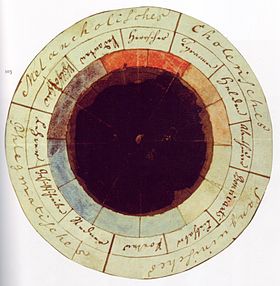
The "rose of temperaments" (Temperamenten-Rose) compiled past Goethe and Schiller in 1798/9. The diagram matches twelve colors to homo occupations or their grapheme traits, grouped in the four temperaments: * choleric (ruby/orange/yellow): tyrants, heroes, adventurers * sanguine (yellow/greenish/cyan) hedonists, lovers, poets * phlegmatic (cyan/blue/violet): public speakers, historians * melancholic (violet/magenta/red): philosophers, pedants, rulers
Color psychology is the study of hues equally a determinant of human behavior. Carl Jung has been credited every bit i of the pioneers in this field for his explorations into the properties and meanings of colors in our lives. Jung is quoted for saying, "colours are the female parent tongue of the subconscious"[1] Color influences perceptions that are not obvious, such every bit the taste of food. Colors have qualities that can cause sure emotions in people.[2] Colors tin also raise the effectiveness of placebos.[three] For example, ruddy or orange pills are generally used as stimulants.[3] How color influences individuals may differ depending on age, gender, and civilisation. For instance, heterosexual men tend to study that reddish outfits enhance female bewitchery, while heterosexual females deny whatsoever outfit color impacting that of men.[4] Although color associations can vary contextually betwixt cultures, color preference is to exist relatively uniform beyond gender and race.[5]
Color psychology is as well widely used in marketing and branding. Marketers run across colour equally important, equally color can influence a consumers' emotions and perceptions near appurtenances and services.[one] Logos for companies are important, since the logos tin can attract more than customers. This happens when customers believe the visitor logo matches the personality of the goods and services, such as the color pink heavily used on Victoria'south Cloak-and-dagger branding.[6] Colors are as well of import for window displays in stores. Research shows that colors such every bit red tended to attract spontaneous purchasers, despite cool colors such as blue being more favorable.[7] Reddish and xanthous, as a combination, tin stimulate hunger, which may aid to explicate, in part, the success of fast-nutrient restaurants such as McDonald's, Burger King, and In-N-Out Burger.[8] The phenomenon has been referred to as the "ketchup & mustard" theory.[9]
While marketing makes lucrative use of color psychology'southward principles, the applications of the field touch many other domains such equally in medical therapies, sports, infirmary settings, and fifty-fifty in game blueprint.
History [edit]
Before there was color psychology every bit a field, colour was being used for centuries every bit a method of treatment as early on equally 2000 BC. The aboriginal Egyptians documented colour "cures" using painted rooms or sunlight shining through crystals as therapy. One of the earliest medical documents, the Nei Ching, documents colour diagnoses associated with color healing practices.[10]
Carl Jung is most prominently associated with the pioneering stages of color psychology in the 20th century. Jung was nigh interested in colors' properties and meanings, likewise equally in art's potential every bit a tool for psychotherapy. His studies in and writings on colour symbolism cover a wide range of topics, from mandalas to the works of Picasso to the near-universal sovereignty of the color gold, the lattermost of which, co-ordinate to Charles A. Riley 2, "expresses... the apex of spirituality, and intuition".[11] In pursuing his studies of color usage and effects across cultures and time periods, as well as in examining his patients' self-created mandalas, Jung attempted to unlock and develop a language, or code, the ciphers of which would be colors. He looked to alchemy to further his agreement of the secret language of colour, finding the key to his research in alchemical transmutation. His work has historically informed the modern field of color psychology.
Model of colour psychology [edit]
The general model of color psychology relies on 6 basic principles:
- Color can carry a specific pregnant.
- Color meaning is either based in learned meaning or biologically innate meaning.
- The perception of a color causes evaluation automatically by the person perceiving.
- The evaluation process forces color-motivated behavior.
- Color ordinarily exerts its influence automatically.
- Color meaning and event has to practice with context also.[seven]
Influence of colour on perception [edit]
Multiple researchers advise that 1 factor in the evolution of primate trichromatic colour vision is to allow for better perception of others' emotions or condition which tin prove highly useful for complex social interaction.[12] For case, flushed or pale skin can non-verbally communicate whether they are excited or sickly. Likewise its apply for social situations, colour has an bear on in multiple facets of our perceptions.
Sense of taste [edit]
Color as well affects how people perceive the edibility and season of foods and drinks.[13] Not only the color of the nutrient itself just also that of everything in the eater's field of vision can touch this. For example, in food stores, bread is normally sold in packaging decorated or tinted with aureate or brown tones to promote the idea of home broiled and oven freshness.[xiv] People can error a blood-red flavored drink for being lime or lemon flavored if that drink was a dark-green color. Additionally, a flavor can be intensified by a color. People can rate a brown Thou&Thousand as more than chocolate flavored than a green Chiliad&Thousand based on color.[xiii] This interaction can be mediated past our perceptions as well, specially depending on cultural expectation. Research in the UK demonstrated that individuals receiving a brown potable would accept different expectations for the taste (i.e. expecting a Cola) while someone from Taiwan may await a grape flavored drink considering of popular drinks in their culture.[fifteen]
Fourth dimension [edit]
Recent results[16] showed that the perceived duration of a cherry screen was longer than was that of a blueish screen. The results reflected sexual activity differences; men, but not women, overestimated the duration of the red screen. Additionally, the reaction times to a carmine screen were faster than those to a bluish screen. Participants who reacted quickly to a red screen overestimated its duration. In a demo with 150 people chosen at random, information technology was constitute that inside a pod bathed in blue colour the average perceived duration of a minute was 11 seconds shorter than in a pod bathed in carmine color.[17] Notwithstanding, another study looking at perceived duration constitute opposite results regarding blue and blood-red stimuli.[xviii]
Lite [edit]
Light and color influence how people encounter their surroundings. Unlike types of low-cal sources touch interior or external objects by visually changing their surface colors. Specific hues observed under natural sunlight may vary when seen under the low-cal from an incandescent (tungsten) lite-bulb: lighter colors may announced to be more than orangish or "brown" and darker colors may announced even darker.[19] Lite and the color of an object tin affect how one perceives its positioning. If light or shadow, or the color of the object, masks an object'due south truthful contour (outline of a figure) it can appear to exist shaped differently from reality.[19] Objects under a uniform lite-source volition promote meliorate impression of three-dimensional shape.[19] The color of an object may bear upon whether or non information technology seems to be in motion. In particular, the trajectories of objects nether a light source whose intensity varies with space are more than difficult to determine than identical objects nether a uniform light source. This could perchance be interpreted every bit interference between motion and color perception, both of which are more than hard under variable lighting.[19]
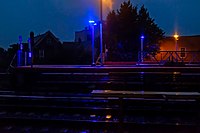
Blue light causes people to feel relaxed, which has led countries to add blueish street lights in lodge to decrease suicide rates.[20] In 2000, the urban center of Glasgow installed blue street lighting in certain neighborhoods and later on reported the anecdotal finding of reduced crime in these areas.[21] [22] A railroad company in Japan installed bluish lighting on its stations in Oct 2009 in an effort to reduce the number of suicide attempts,[23] although the event of this technique has been questioned.[24]
Medicine [edit]
The color of placebo pills is reported to be a gene in their effectiveness, with "hot-colored" (blood-red, yellow, etc.) pills working improve as stimulants and "cool-colored" (blueish, purple, etc.) pills working amend as depressants. This relationship is believed to be a result of the patient's expectations and not a straight result of the color itself.[three] Consequently, these effects announced to be culture-dependent.[25]
Colour preference and the connexion between colour and emotion [edit]
How people reply to different color stimuli varies from person to person. In a U.South. study, blue is the top choice at 35%, followed by green (16%), majestic (10%) and red (ix%).[26] Bluish and light-green may be due to a preference for certain habitats that were benign in the bequeathed environment as explained in evolutionary aesthetics.[27] Orangish, yellow, and chocolate-brown are the least popular colors, respectively.[28]
One theory for why people prefer one color over another is chosen ecological valence theory (EVT) proposed by Stephen Palmer and Karen Schloss.[29] This theory asserts that people tend to like or dislike colors based on their associations of the color to other objects or situations that they have strong feelings about. For example, if someone associates the colour blueish with make clean water, they would be more likely to favor blue. On the other mitt, people's dislike of the color brown could be due to associations of information technology with feces or rotten food.
Color preference may likewise depend on ambient temperature. People who are cold ofttimes select warm colors such every bit red or yellow, while people who are hot favor absurd colors like blue and green.[vii] Introverted individuals are too found to exist more attracted to absurd colors, while extroverts prefer warmer colors.[30]
Psychologist Andrew J. Elliot tested to see if the color of a person's clothing could make them appear more sexually appealing. He plant heterosexual men and women dressed in cherry were significantly more likely to attract romantic attention than women dressed in whatsoever other color. The color did not bear upon heterosexual women's cess of other women'due south attractiveness. Other studies have shown men dressed in red entreatment to heterosexual women.[iv]
Uses in marketing [edit]
Since colour is an of import cistron in the visual appearance of products as well as in make recognition, color psychology has go important to marketing. Contempo work in marketing has shown that colour can be used to communicate brand personality.[31]
Marketers must be aware of the awarding of color in different media (e.chiliad. print vs. spider web), besides every bit the varying meanings and emotions that a particular audience tin can assign to color. Even though there are attempts to classify consumer response to different colors, everyone perceives colour differently. The physiological and emotional effect of colour in each person is influenced by several factors such as past experiences, civilization, religion, natural environment, gender, race, and nationality. When making color decisions, it is important to determine the target audience in order to convey the correct bulletin. Color decisions tin can influence both directly messages and secondary brand values and attributes in any communication. Color should be carefully selected to align with the key message and emotions being conveyed in a slice.[32]
Enquiry on the effects of colour on product preference and marketing shows that product color could affect consumer preference and hence purchasing civilization. This is mostly due to associative learning. Most results testify that information technology is not a specific color that attracts all audiences, but that certain colors are deemed advisable for certain products.[33]
Brand pregnant [edit]
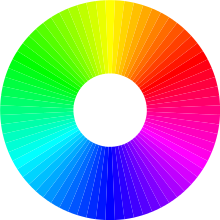
Color is a very influential source of information when people are making a purchasing decision.[34] Customers more often than not make an initial judgment on a production within 90 seconds of interaction with that product and almost 62%-90% of that judgment is based on color.[34] People often come across the logo of a brand or company every bit a representation of that company. Without prior experience to a logo, nosotros brainstorm to associate a brand with sure characteristics based on the principal logo colour.[35]
Color mapping provides a means of identifying potential logo colors for new brands and ensuring brand differentiation inside a visually cluttered market place.[36] [ failed verification ]
A written report on logo color asked participants to charge per unit how advisable the logo colour was for fictional companies based on the products each company produced. Participants were presented with fictional products in eight different colors and had to rate the appropriateness of the color for each product. This study showed a pattern of logo color appropriateness based on product function. If the product was considered functional, fulfills a need or solves a problem, and so a functional colour was seen as most appropriate. If the product was seen as sensory-social, conveys attitudes, status, or social approval, and then sensory-social colors were seen as more appropriate.[35] Companies should decide what types of products to produce and then choose a logo colour that is connotative with their products' functions.
Company logos tin can portray meaning merely through the employ of colour.[37] Colour affects people's perceptions of a new or unknown visitor. Some companies such as Victoria'south Secret and H&R Block used color to change their corporate prototype and create a new brand personality for a specific target audience.[37] Enquiry done on the relationship betwixt logo color and five personality traits had participants rate a calculator-made logo in different colors on scales relating to the dimensions of brand personality. Relationships were institute betwixt color and sincerity, excitement, competence, sophistication, and ruggedness. A follow upwards written report tested the furnishings of perceived make personality and purchasing intentions.[37] Participants were presented with a product and a summary of the preferred brand personality and had to charge per unit the likelihood of purchasing a production based on packaging color. Purchasing intent was greater if the perceived personality matched the marketed product or service. In turn color affects perceived brand personality and make personality affects purchasing intent.[37]
Although colour can be useful in marketing, its value and extent of employ depends on how it is used and the audience it is used on.[38] The use of colour will have different effects on different people, therefore experimental findings cannot be taken every bit universally true.
Specific colour meaning [edit]
Different colors are perceived to hateful dissimilar things. For example, tones of ruby lead to feelings of arousal while bluish tones are frequently associated with feelings of relaxation. Both of these emotions are pleasant, so therefore, the colors themselves tin can procure positive feelings in advertisements. The chart beneath gives perceived meanings of different colors in the U.s..
Functional (F): fulfills a demand or solves a trouble[35]
Sensory-Social (S): conveys attitudes, condition, or social approval[35]
| Red | Yellow | Green | Blue | Pinkish | Violet/Purple | Orange | Brownish | Blackness | White |
|---|---|---|---|---|---|---|---|---|---|
| Lust (Southward)[39] | Competence (S)[37] | Good Taste (F)[39] | Sophistication (S)[37] | Authority (S)[39] | Warmth (S)[xl] | Ruggedness (S)[37] | Grief (South)[39] | Happiness (S)[39] | |
| Power (S)[41] | Happiness (S)[39] | Envy (S)[39] | Competence (S)[37] | Sincerity (Southward)[37] | Sophistication (S)[37] | Excitement (S)[40] | Sophistication (S)[37] | Sincerity (S)[37] | |
| Excitement (Due south)[37] | Inexpensive (F)[28] | Eco-Friendly (F) [42] | High quality (F)[39] | Feminine and Flirty (Due south)[39] | Power (S)[39] | Expensive (F)[39] | Purity (Due south)[39] | ||
| Dearest (Due south)[39] | Low Quality (F)[28] | Health (S) [42] | Corporate (F)[39] | Fearfulness (Southward)[39] | |||||
| Speed (S) [5] | Coin (F)[43] | Reliability (F) [28] | |||||||
| Anger (S)[44] |
Meanings in cartography [edit]

This map of precipitation leverages the natural connotations of bluish as wet and yellow as dry, only readers take to make a conscious attempt to non interpret green equally vegetation
In map design, additional colour meanings are ordinarily employed to create intuitive map symbols, due to the natural colors of common geographic features.[45] These correlations are commonly stylized and conventionalized, then that the color with the well-nigh intuitive meaning is often the nearest prototypical named color rather than that most similar to the real-world color (e.1000., in very rare locations is water equally deep and pure a blue as is unremarkably used in maps). Mutual (but by no means administrative or exhaustive) examples include:
- Greenish: vegetation
- Blue: water (water bodies, precipitation), cold
- Yellow: dryness
- Chocolate-brown: soil
- Red: oestrus, wildfire
- Purple: unnatural (contrasting with natural connotations of green, yellow, blue)
- Grayness/Black: man structures (roads, buildings)
Other colors tin can accept intuitive meaning due to their function in Gestalt psychology and other cognitive aspects of the map-reading process. For case, shades that dissimilarity almost with the background (i.e., night on a white page, light on a night screen) are naturally perceived every bit "more than" (college values of quantitative backdrop, more important in the Visual hierarchy) than shades with less contrast.
Combining colors [edit]

Although some companies use a unmarried color to stand for their brand, many other companies use a combination of colors in their logo, and can exist perceived in different ways than those colors independently. When asked to rate colour pair preference of preselected pairs, people generally prefer colour pairs with similar hues when the two colors are both in the foreground; yet, greater dissimilarity between the figure and the groundwork is preferred.[46]
In contrast to a strong preference for like color combinations, some people like to accent with a highly contrasting colour.[47] In a study on color preference for Nike, Inc. sneakers, people by and large combined colors nearly each other on the color wheel, such as blue and dark blue. However, a smaller segment preferred to take the Nike swoosh accentuated in a unlike, and contrasting, color. Most of the people as well used a relatively small number of colors when designing their platonic able-bodied shoe. This finding has relevance for companies that produce multicolored trade, suggesting that to appeal to consumer preferences, companies should consider minimizing the number of colors visible and using similar hues in whatsoever one production.[48]
Colour proper noun [edit]
Although dissimilar colors can exist perceived in different ways, the names of those colors matters as well.[48] [49] These names are ofttimes chosen visual colour descriptors. Many products and companies focus on producing a wide range of product colors to attract the largest population of consumers. For case, cosmetics brands produce a rainbow of colors for eye shadow and nail smooth, to appeal to every blazon of person. Even companies such as Apple Inc. and Dell who make iPods and laptops exercise so with a certain corporeality of color personalization bachelor to concenter buyers. Moreover, color proper noun, not just the actual color, can attract or repel buyers likewise. When asked to rate color swatches and products with either generic color names (such as brown) or "fancy" color names (such equally mocha), participants rated items with fancy names equally significantly more likable than items with generic names.[48] In fact, the same paint color swatch with ii different names produced unlike rating levels, and the same effect was found when participants rated the pleasantness of towels given fancy or generic color names,[48] showing an overall pattern of preference for fancy color names over generic ones when describing exactly the same color.
Furthermore, it would appear that in addition to fancy names being preferred for their audible appeal, they may actually contribute to the product they correspond itself beingness liked more, and hence in this manner touch on sales.[l] A yellow jelly bean with an atypical color name such as razzmatazz is more than likely to be selected than one with a more typical name such as lemon xanthous. This could be due to greater involvement in singular names, also every bit curiosity and willingness to "effigy out" why that name was called. Purchasing intent patterns regarding custom sweatshirts from an online vendor also revealed a preference for atypical names. Participants were asked to imagine ownership sweatshirts and were provided with a variety of color name options, some typical, some atypical. Color names that were atypical were selected more often than typical color names, again confirming a preference for atypical color names and for particular descriptions using those names.[fifty] Moreover, those who chose sweatshirts bearing atypical color names were described as more than content with their purchase than those who selected similar items bearing typical color names.
Attracting attention [edit]

A shop sign painted mainly red on a street in Bangkok to concenter attention from passers-by
Color is used as a means to attract consumer attending to a product that then influences buying beliefs.[51] Consumers utilise color to place for known brands or search for new alternatives. Diverseness seekers look for non-typical colors when selecting new brands. Attractive color packaging receives more consumer attention than unattractive color packaging, which can then influence buying behavior. A study that looked at visual color cues focused on predicted purchasing behavior for known and unknown brands.[51] Participants were shown the aforementioned product in four different colors and brands. The results showed that people picked packages based on colors that attracted their voluntary and involuntary attending. Associations fabricated with that colour such equally 'light-green fits menthol', also affected their decision. Based on these findings implications can be made on the best colour choices for packages. New companies or new products could consider using dissimilar colors to attract attention to the brand, but off-make companies could consider using similar colors to the leading brand to emphasize production similarity. If a company is changing the look of a product, just keeping the product the aforementioned, they consider keeping the same color scheme since people apply color to identify and search for brands.[51] This can be seen in Crayola crayons, where the logo has changed many times since 1934, only the bones package colors, gold and green, have been kept throughout.
Attending is captured subconsciously before people can consciously nourish to something.[52] Research looking at electroencephalography (EEGs) while people made decisions on color preference found brain activation when a favorite color is present earlier the participants consciously focused on it. When looking at various colors on a screen people focus on their favorite color, or the color that stands out more than, earlier they purposefully plough their attending to it. This implies that products can capture someone's attention based on color, before the person willingly looks at the product.[52]
In interactive design and behavioral design, color is used to develop visual hierarchies where colors are placed into saliency hierarchies that lucifer other hierarchies. Examples include matching a colour hierarchy to a navigational structure hierarchy, or matching a behavioral science hierarchy to the most salient colors in a visual hierarchy, to increase the odds that important behavior alter principles are noticed by a target audience and candy by them.[53]
Store and display colour [edit]

Warm colored window display
Colour is not only used in products to concenter attention, but besides in window displays and stores.[54] When people are exposed to different colored walls and images of window displays and shop interiors they tend to be drawn to some colors and non to others. Findings showed that people were physically drawn to warm colored displays; however, they rated cool colored displays equally more than favorable. This implies that warm colored store displays are more appropriate for spontaneous and unplanned purchases, whereas cool colored displays and store entrances may be a better fit for purchases where a lot of planning and customer deliberation occurs. This is especially relevant in shopping malls where patrons could easily walk into a store that attracts their attending without previous planning.[54]
Other research has confirmed that store colour, and not just the product, influences buying behavior.[49] When people are exposed to different store colour scenarios and then surveyed on intended ownership beliefs, store color, amidst diverse other factors, seems of import for purchasing intentions. Particularly blue, a cool color, was rated as more favorable and produced higher purchasing intentions than orange, a warm color. However, all negative effects to orange were neutralized when orange store colour was paired with soft lighting. This shows that store color and lighting really interact.[49]
Lighting colour could take a strong outcome on perceived experience in stores and other situation. For instance, fourth dimension seems to pass more slowly under crimson lights and fourth dimension seems to pass speedily under blueish low-cal.[34] Casinos take full reward of this phenomenon by using color to get people to spend more fourth dimension and hence more than money in their casino.[34] Nonetheless, a presumed influence of colored lite (cerise vs. blue) on risk behavior could non be demonstrated.[55]
Applications for therapy [edit]

Art therapist Felicity Kodjo watches over a patient during an fine art therapy workshop.
Fine art therapy [edit]
Fine art therapy is a dissever just related field of applied psychology. It comes from psychoanalytic theories in the 1970s that argued that some of our emotions and experiences cannot just be expressed in words, but in images and colors.[56] One intersection where colour psychology could exist of use to art therapists is in evaluating what certain colors hateful to clients when they use them to create fine art pieces. Even the lack of color use can be an important detail in art therapy, as people struggling with depression tend to use less color when they are painting.[56] It'due south besides suggested that by focusing on color apply rather than the resulting image made by a client, y'all can avert clients' anxiety over producing a "good" production and focus more on what the colors they used mean to them in social club to kickoff a dialogue about their feelings.[56]
Chromotherapy [edit]
Chromotherapy is a handling method adjusted from ancient colour-based practices that uses wavelengths in the visual spectrum (colors we can see) to treat different weather condition.[57] This therapy has been researched to treat multiple physiological and psychiatric conditions, such equally seasonal affective disorder (SAD), age-related cerebral decline, depression, and hypertension amidst others.[58] [59] [60] However, many in the healthcare field believe that chromotherapy does not have a robust research backing and have described it as a pseudoscience.[61] Other sources merits that while sure colors have been shown equally beneficial to wellbeing, the clear definition of what wavelengths are beneficial and exactly how these benefits occur is not clear enough to put them to use in a medical setting.[62]
Individual differences [edit]
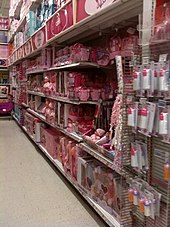
Pinkish girls section of toy shop
Gender [edit]
Children's toys are ofttimes categorized as either boys or girls toys solely based on color. In a written report on color effects on perception, developed participants were shown blurred images of children's toys where the simply decipherable feature visible was the toy'due south color.[63] In general participants categorized the toys into girl and boy toys based on the visible color of the image. This can be seen in companies interested in marketing masculine toys, such as building sets, to boys. For instance, Lego uses pinkish to specifically advertise some sets to girls rather than boys. The nomenclature of 'daughter' and 'boy' toys on the Disney Store website also uses colour associations for each gender.[64] An analysis of the colors used showed that bold colored toys, such as red and black, were generally classified equally 'boy simply' toys and pastel colored toys, such equally pink and majestic, were classified as 'girl just' toys. Toys that were classified as both boy and girl toys took on 'boy but' toy colors. This once more emphasizes the stardom in colour use for children'south toys.[64]
Gender differences in color associations can also be seen amidst adults.[65] Differences were noted for male and female person participants, where the ii genders did not concord on which colour pairs they enjoyed the most when presented with a variety of colors.[63] [66] Men and women also did not concur on which colors should exist classified every bit masculine and feminine. This could imply that men and women more often than not prefer dissimilar colors when purchasing items. Men and women also misperceive what colors the opposite gender views equally plumbing equipment for them.
Gender has also shown to influence how colors are received, with some research suggesting women and men respectively prefer "warm" and "cool" colors.[vii] Blackness, white, and gray, every bit tones or shades, were shown to be received more positively by males than females.[34]
Age [edit]
Children'south toys for younger age groups are ofttimes marketed based on color, but equally the historic period group increases, colour becomes less gender-stereotyped.[63] In general many toys go gender neutral and hence adopt gender-neutral colors. In the United states information technology is mutual to associate infant girls with pink and baby boys with bluish. This departure in young children is a learned difference rather than an inborn one.[67] Inquiry has looked at the preference of immature children, ages 7 months to 5 years, for small objects in different colors. The results showed that by the age of 2–2.v years socially synthetic gendered colors affects children's color preference, where girls adopt pink and boys avoid pink, but testify no preference for other colors.[67]
Contrary to the adult fondness for blue, in children yellow is the most favored color, perhaps owing to its associations with happiness.[39] However, children like colors they find to be pleasant and comforting and their preferences don't change much, while developed color preference is usually easily influenced.[7] Slightly older children who accept developed a sense of favorite color often tend to pick items that are in that color.[68]
Ecological valence theory has been cited as a possible reason for differences in color preferences between adults and infants.[69] Because adults have more associations betwixt colors and objects or places from life experiences, their preferences are alter equally they become older.
Culture [edit]
Many cultural differences exist on perceived color personality, significant, and preference. When deciding on brand and product logos, companies should accept into account their target consumer, since cultural differences exist. A study looked at color preference in British and Chinese participants.[65] Each participant was presented with a total of 20 color swatches one at a fourth dimension and had to rate the colour on 10 dissimilar emotions. Results showed that British participants and Chinese participants differed on the like-dislike scale the most. Chinese participants tended to like colors that they self rated equally clean, fresh, and modern, whereas British participants showed no such pattern. When evaluating purchasing intent, colour preference affects ownership behavior, where liked colors are more probable to be bought than disliked colors.[51] This implies that companies should consider choosing their target consumer first and and then make production colors based on the target'due south colour preferences.
Wollard, (2000)[70] seems to think that color can affect ane's mood, but the consequence also can depend on i's civilisation and what one's personal reflection may exist. For example, someone from Nippon may non associate red with anger, as people from the U.S. tend to do. As well, a person who likes the color chocolate-brown may associate brown with happiness. However, Wollard does think that colors tin make anybody feel the same, or close to the same, mood.
Studies have shown people from the aforementioned region, regardless of ethnicity, volition have the same color preferences. Mutual associations connecting colors to a particular emotion may likewise differ cantankerous-culturally.[seven] For case, one study examined color relationships with emotion with participants in Germany, United mexican states, Poland, Russian federation, and the United States; finding that ruddy was associated with anger and viewed every bit stiff and agile.[71] Withal, only Poles related regal with both anger and jealousy while Germans linked jealousy with yellow. This highlights how the influence of different cultures can potentially modify perceptions of color and its human relationship to emotion.[xix]
Sports performance [edit]

Ed Banach wrestles Akira Ohta during the 1984 Summer Olympics.
In particular, the color red has been institute to influence sports performance. During the 2004 Summertime Olympics the competitors in boxing, taekwondo, freestyle wrestling, and Greco-Roman wrestling were randomly given blue or reddish uniforms. A later written report found that those wearing red won 55% of all the bouts which was a statistically significant increase over the expected 50%. The colors afflicted bouts where the competitors were closely matched in ability, where those wearing red won 60% of the bouts, but non bouts between more unevenly matched competitors. In England, since WWII, teams wearing scarlet uniforms have averaged college league positions and accept had more league winners than teams using other colors. In cities with more than than i team, the teams wearing red outperformed the teams wearing other colors. A study of the UEFA Euro 2004 found like results. Another study constitute that those taking penalisation kicks performed worst when the goalkeeper had a red uniform. More than anecdotal is the historical dominance of the domestic honors by cerise-wearing teams such AFC Ajax, FC Bayern Munich, Liverpool F.C., and Manchester United F.C. Videos of taekwondo bouts were manipulated in ane study so that the cherry and blueish colors of the protective gears were reversed. Both the original and the manipulated videos were shown to referees. The competitors wearing cerise were given higher scores despite the videos otherwise being identical. A study on experienced players of first-person shooters found that those assigned to wear red instead of blue won 55% of the matches.[71]
There are several different explanations for this effect. Cerise is used in stop signs and traffic lights which may acquaintance the color with halting. Red is also perceived as a strong and active colour which may influence both the person wearing it and others. An evolutionary psychology explanation is that red may signal health as opposed to anemic paleness, or indicate anger due to flushing instead of paleness due to fear. It has been argued that detecting flushing may take influenced the development of primate trichromate vision. Primate studies have plant that some species evaluate rivals and possible mates depending on red colour characteristics. Facial redness is associated with testosterone levels in humans, and male pare tends to exist redder than female pare.[71]
Utilize in hospitals [edit]
At the turn of the 20th century, white was widely used in hospitals. In 1914, a surgeon in a San Francisco hospital, Harry Sherman, adopted green, "the complementary color to hemaglobin" to avoid dazzle. This was adopted by a number of other American hospitals in the following decades. At around the same time, architect William Ludlow began to abet pale pastel dejection and greens in hospitals for therapeutic purposes and advising that "white is negative". In 1930, Dr. Charles Republic of ireland of Guy'south Infirmary in London wrote Color and Cancer, a volume advocating the use of concentrated doses of colored light for treating cancer. The practice of using color in hospitals became widespread in the 1930s, particularly promoted by Faber Birren, who established himself every bit an "industrial color consultant" in 1934 and advised that an surround of soft colors, peculiarly green, would be soothing for patients.[72]
Gaming [edit]
Since color is such an important element in how people interpret their environment, color psychology can enhance the feeling of immersion in people that play video games. By using color psychology to crusade immersion in players, players can take less errors playing video games and feel more than a office of the game they were playing in comparing to a game that did not take color psychology immersion.[2]
See also [edit]
- Color symbolism
- Color vision
- Kruithof curve
- Lüscher color examination
- Visual perception
References [edit]
- ^ a b "CHARACTER COSTUME DESIGN CREATION", Grapheme Costume Effigy Cartoon, Routledge, pp. 169–183, 2013-03-20, ISBN978-0-08-095407-three , retrieved 2022-05-04
- ^ a b Roohi S, Forouzandeh A (May 2019). "Regarding color psychology principles in adventure games to heighten the sense of immersion". Amusement Computing. 30: 100298. doi:10.1016/j.entcom.2019.100298. ISSN 1875-9521. S2CID 133023544.
- ^ a b c de Craen AJ, Roos PJ, de Vries AL, Kleijnen J (1996). "Effect of color of drugs: systematic review of perceived effect of drugs and of their effectiveness". BMJ. 313 (7072): 1624–1626. doi:10.1136/bmj.313.7072.1624. PMC2359128. PMID 8991013.
- ^ a b Alter A (March 21, 2013). "I See Red". Slate.
- ^ a b Birren F (1961). Colour Psychology & Color Therapy. Secaucus, N. J: The Citadel Printing. p. 198. ISBN0806506539.
- ^ Elliot AJ, Maier MA (2014). "Color psychology: effects of perceiving colour on psychological functioning in humans". Almanac Review of Psychology. 65: 95–120. doi:10.1146/annurev-psych-010213-115035. PMID 23808916.
- ^ a b c d due east f Whitfield TW, Wiltshire TJ (Nov 1990). "Colour psychology: a disquisitional review". Genetic, Social, and General Psychology Monographs. 116 (4): 385–411. PMID 2289687.
- ^ "Why You Experience Hungry When You Encounter The Colour Red". So Yummy. 2019-01-14. Retrieved 2021-09-08 .
- ^ Findlay P (2018-09-12). "The ketchup and mustard theory of advertising, AKA learning to taste your brand". Mumbrella . Retrieved 2021-09-08 .
- ^ "Colour History". Colour Therapy Healing. 2016-04-01. Retrieved 2021-11-20 .
- ^ Riley, Charles A. II. "Color Codes: Modern Theories of Color in Philosophy, Painting and Architecture, Literature, Music, and Psychology". Hanover: University Press of New England, 1995, p. 307.
- ^ Elliot AJ, Maier MA (2014-01-03). "Colour psychology: effects of perceiving color on psychological functioning in humans". Annual Review of Psychology. 65 (ane): 95–120. doi:10.1146/annurev-psych-010213-115035. PMID 23808916.
- ^ a b Shankar MU, Levitan C, Prescott J, Spence C (2009-04-28). "The Influence of Color and Label Information on Flavor Perception". Chemosensory Perception. 2 (2): 53–58. doi:10.1007/s12078-009-9046-4. ISSN 1936-5802. S2CID 59026706.
- ^ Bleicher S (2012). Contemporary Colour: Theory & Use. New York: Delmar. pp. 48, fifty. ISBN978-1-1335-7997-7.
- ^ Shankar MU, Levitan CA, Spence C (March 2010). "Grape expectations: the role of cognitive influences in color-flavor interactions". Consciousness and Noesis. 19 (1): 380–390. doi:10.1016/j.concog.2009.08.008. PMID 19828330. S2CID 32230245.
- ^ Masahiro Shibasaki, Nobuo Masataka (2014) "The color red distorts time perception for men, just not for women" Scientific Reports four, Article number: 5899 doi:10.1038/srep05899
- ^ Swain Lotto in "Practice Y'all Run into What I Come across" (2011)
- ^ Makwana Chiliad (2018-02-26). "The effects of color on time perception – Blueish stimuli are temporally overestimated". Timing Research Forum . Retrieved 2021-10-02 .
- ^ a b c d e Shevell SK, Kingdom FA (2008). "Color in complex scenes". Annual Review of Psychology. 59: 143–166. doi:10.1146/annurev.psych.59.103006.093619. PMID 18154500. S2CID 24460261.
- ^ Baraniuk C. "Tin can blue lights prevent suicide at train stations?". www.bbc.com . Retrieved 2020-03-xi .
- ^ "Blueish streetlights believed to preclude suicides, street crime". The Seattle Times. 2008-12-eleven. Archived from the original on September 13, 2010.
- ^ Shimbun Y (December 10, 2008). "Blue streetlights may prevent criminal offense, suicide". Archived from the original on 2009-ten-09. Retrieved 2010-02-18 .
- ^ "Can Blue-Colored Light Preclude Suicide?". Archived from the original on 2017-12-15. Retrieved 2010-02-18 .
- ^ Will Blue Lights Reduce Suicides in Japan?
- ^ Dolinska B (1999). "Empirical investigation into placebo effectiveness" (PDF). Irish Journal of Psychological Medicine. sixteen (2): 57–58. doi:10.1017/s0790966700005176. Archived from the original (w) on 2011-07-22. Retrieved 2009-04-29 .
- ^ Lamancusa K. "Emotional Reactions to Color". Artistic Latitude. Archived from the original on 2016-03-11. Retrieved 2016-03-30 .
- ^ Dutton, Denis. 2003. 'Aesthetics and Evolutionary Psychology' in "The Oxford Handbook for Aesthetics". Oxford University Press.
- ^ a b c d "Colour Consignment - Past Joe Hallock". www.joehallock.com . Retrieved 2020-03-26 .
- ^ Palmer SE, Schloss KB (May 2010). "An ecological valence theory of human color preference". Proceedings of the National Academy of Sciences of the United States of America. 107 (xix): 8877–8882. Bibcode:2010PNAS..107.8877P. doi:10.1073/pnas.0906172107. PMC2889342. PMID 20421475.
- ^ Lichtlé MC (2007-01-01). "The effect of an advertisement's color on emotions evoked by mental attitude towards the advertising". International Periodical of Advertizing. 26 (1): 37–62. doi:x.1080/02650487.2007.11072995. ISSN 0265-0487. S2CID 142662891.
- ^ Labrecque LI, Milne GR (2012). "Exciting Ruddy and Competent Bluish: The Importance of Color in Marketing". Periodical of the Academy of Marketing Science. 40 (five): 711–727. doi:ten.1007/s11747-010-0245-y. S2CID 167731928.
- ^ Connecting With Colour
- ^ Fernández-Vázquez R (2011). "Visual and Instrumental Evaluation of Orange Juice Color: A Consumers' Preference Study". Journal of Sensory Studies. 26 (6): 436–444. doi:10.1111/j.1745-459X.2011.00360.x.
- ^ a b c d e Singh Due south (2006). "Impact of color on marketing". Direction Decision. 44 (6): 783–789. doi:10.1108/00251740610673332.
- ^ a b c d Bottomley PA, Doyle JR (2006). "The interactive effects of colors and products on perceptions of make logo appropriateness". Marketing Theory. vi (1): 63–83. doi:10.1177/1470593106061263. S2CID 53464180.
- ^ O'Connor Z. "Logo colour and differentiation: A new application of colour mapping". Colour Enquiry & Application, 36 (1), p55-60 . Retrieved 2016-03-30 .
- ^ a b c d e f g h i j k 50 m Labrecque LI, Milne GR (2011). "Exciting reddish and competent blue: the importance of color in marketing". Journal of the University of Marketing Scientific discipline. 40 (5): 711–727. doi:10.1007/s11747-010-0245-y. S2CID 167731928.
- ^ Warner L, Franzen R (June 1947). "Value of colour in advertising". The Periodical of Practical Psychology. 31 (3): 260–270. doi:10.1037/h0057772. PMID 20241978.
- ^ a b c d eastward f thou h i j thousand l m n o p Aslam MM (2006). "Are You lot Selling the Right Colour? A Cantankerous-cultural Review of Colour as a Marketing Cue". Journal of Marketing Communications. 12 (1): xv–30. doi:10.1080/13527260500247827. S2CID 168153362.
- ^ a b Elliot AJ (2015-04-02). "Color and psychological functioning: a review of theoretical and empirical work". Frontiers in Psychology. half dozen: 368. doi:10.3389/fpsyg.2015.00368. PMC4383146. PMID 25883578.
- ^ Piotrowski C, Armstrong T (2012). "Color Red: Implications for applied psychology and marketing research". Psychology and Education. 49 (i–2): 55–57.
- ^ a b Lupton E (2017). Blueprint is storytelling. New York, NY. ISBN978-1-942303-nineteen-0. OCLC 982650081.
- ^ Edward T. Vieira, Jr., Public Relations Planning: A Strategic Approach (2018), p. 230.
- ^ Kauppinen-Räisänen H, Jauffret MN (2018-01-08). "Using colour semiotics to explore color meanings". Qualitative Market place Inquiry. 21 (1): 101–117. doi:x.1108/QMR-03-2016-0033. ISSN 1352-2752.
- ^ Tyner, Judith A., Principles of Map Design, New York: Guilford Press, 2010, p.64
- ^ Schloss KB, Palmer SE (February 2011). "Aesthetic response to colour combinations: preference, harmony, and similarity". Attention, Perception, & Psychophysics. 73 (2): 551–571. doi:ten.3758/s13414-010-0027-0. PMC3037488. PMID 21264737.
- ^ Deng 10, Hui SK, Huntchinson J (2010). "Consumer preferences for color combinations: An empirical assay of similarity-based color". Journal of Consumer Psychology. 20 (4): 476–484. doi:x.1016/j.jcps.2010.07.005.
- ^ a b c d Skorinko JL, Kemmer S, Hebl MR, Lane DM (2006). "fifteen. A Rose by Whatever Other Name...: Colour-Naming Influences on Decision Making". Psychology & Marketing. 23 (12): 975–993. CiteSeerXx.i.1.581.1374. doi:ten.1002/mar.20142.
- ^ a b c Babin BJ, Hardesty DM, Suter TA (2003). "Color and shopping intentions". Periodical of Business Research. 56 (vii): 541–551. doi:10.1016/S0148-2963(01)00246-6.
- ^ a b Miller EG, Kahn BE (2005). "Shades of Meaning: The Consequence of Colour and Flavor Names on Consumer Pick". Journal of Consumer Inquiry. 32 (one): 86–92. CiteSeerXx.ane.1.488.3177. doi:ten.1086/429602.
- ^ a b c d Kauppinen-Raisanen H, Luomala HT (2010). "Exploring consumers' product-specific color meanings". Qualitative Market Research. thirteen (iii): 287–308. doi:10.1108/13522751011053644.
- ^ a b Kawasaki K, Yamaguchi Y (Jan 2012). "Effects of subjective preference of colors on attending-related occipital theta oscillations". NeuroImage. 59 (1): 808–814. doi:10.1016/j.neuroimage.2011.07.042. PMID 21820064.
- ^ Cugelman, B. Cugeman, R. et al. (2019). Color Psychology. AlterSpark. https://www.alterspark.com/colour-psychology
- ^ a b Bellizzi JA, Crowley AE, Hasty RW (1983). "The effects of color in store blueprint". Journal of Retailing. 59 (one): 21–45.
- ^ Mao T, Yang J, Ru T, Chen Q, Shi H, Zhou J, Zhou G (2018). "Does red low-cal induce people to be riskier? Exploring the colored light effect on the Balloon Analogue Risk Task (BART)". Journal of Ecology Psychology. 57: 73–82. doi:ten.1016/j.jenvp.2018.07.001. S2CID 149927011.
- ^ a b c Withrow RL (2004). "The Use of Color in Fine art Therapy". The Journal of Humanistic Counseling, Educational activity and Evolution. 43 (one): 33–xl. doi:x.1002/j.2164-490X.2004.tb00040.x. ISSN 2164-490X.
- ^ Azeemi ST, Rafiq HM, Ismail I, Kazmi SR, Azeemi A (October 2019). "The mechanistic basis of chromotherapy: Current knowledge and future perspectives". Complementary Therapies in Medicine. 46: 217–222. doi:10.1016/j.ctim.2019.08.025. PMID 31519282. S2CID 202571445.
- ^ Samina T. Yousuf Azeemi, Mohsin Raza, "A Disquisitional Analysis of Chromotherapy and Its Scientific Evolution", Evidence-Based Complementary and Culling Medicine, vol. 2,Article ID 254639, eight pages, 2005. https://doi.org/x.1093/ecam/neh137
- ^ Paragas ED, Ng AT, Reyes DV, Reyes GA (2019-05-01). "Effects of Chromotherapy on the Cognitive Ability of Older Adults: A Quasi-Experimental Study". Explore. 15 (3): 191–197. doi:10.1016/j.explore.2019.01.002. PMID 30718190. S2CID 73443325.
- ^ Glickman K, Byrne B, Pineda C, Hauck WW, Brainard GC (March 2006). "Light therapy for seasonal melancholia disorder with blue narrow-band calorie-free-emitting diodes (LEDs)". Biological Psychiatry. 59 (6): 502–507. doi:10.1016/j.biopsych.2005.07.006. PMID 16165105. S2CID 42586876.
- ^ Swan J (2003). Jonathan Swan's dishonest magic: the dubious history of health fads and cures. London: Ebury Printing. ISBN978-0-09-188809-1. OCLC 52515553.
- ^ Tofle, R.B. (2004). "Color in Healthcare Environments - A Research Study" (PDF). California: Coalition for Health Environments Research. Retrieved November 19, 2021.
- ^ a b c Hull JH, Hull DB, Knopp C (2011). "The Impact of color on ratings of 'daughter' and 'boy' toys". North American Periodical of Psychology. 13 (3): 549–562. 276353296. Archived from the original on 2016-ten-06. Retrieved 2017-02-xiv .
- ^ a b Auster CJ, Mansbach CS (2012). "The Gender Marketing of Toys: An Assay of Color and Type of Toy on the Disney Store Website". Sex Roles. 67 (7–eight): 375–388. doi:10.1007/s11199-012-0177-eight. S2CID 143551702.
- ^ a b Ou LC, Luo MR, Woodcock A, Wright A (2004). "A report of colour emotion and color preference. Role I: Colour emotions for single colours". Colour Research & Application. 29 (3): 232–240. doi:ten.1002/col.20010.
- ^ Ou LC, Luo MR, Woodcock A, Wright A (2004). "A study of colour emotion and colour preference. Part Two: Colour emotions for two-colour combinations". Color Research & Application. 29 (4): 292–298. doi:10.1002/col.20024.
- ^ a b Lobue V, Deloache JS (September 2011). "Pretty in pink: The early development of gender-stereotyped colour preferences". The British Journal of Developmental Psychology. 29 (Pt 3): 656–667. doi:ten.1111/j.2044-835X.2011.02027.x. PMID 21848751. S2CID 23219132.
- ^ Gollety M, Guichard N (2011). "The dilemma of flavor and color in the selection of packaging by children". Young Consumers. 12 (1): 82–90. doi:x.1108/17473611111114803.
- ^ Taylor C, Schloss K, Palmer SE, Franklin A (October 2013). "Colour preferences in infants and adults are different". Psychonomic Message & Review. 20 (5): 916–922. doi:ten.3758/s13423-013-0411-half dozen. PMID 23435629. S2CID 10261601.
- ^ "Wollard, K. (2000). Orangish you glad you lot're not blue?". [ permanent dead link ]
- ^ a b c Diana Widermann, Robert A. Barton, and Russel A. Hill. Evolutionary perspectives on sport and competition. In Roberts SC (2011). Roberts SC (ed.). Applied Evolutionary Psychology. Oxford University Press. doi:ten.1093/acprof:oso/9780199586073.001.0001. ISBN9780199586073.
- ^ Pantalony D (September 2009). "The colour of medicine". CMAJ. 181 (6–seven): 402–403. doi:ten.1503/cmaj.091058. PMC2742127. PMID 19737828.
Source: https://en.wikipedia.org/wiki/Color_psychology
0 Response to "Can You Influence Someone to Wear Red by Saying Red Over and Over Again"
Post a Comment