what does it mean to die with christ?
1 of the most remarkable assertions of the campaigner Paul is that Christians actually die with Christ.
What does this hateful?
Paul explains in a letter to the church of Colossae.
"If with Christ you died to the elemental spirits of the world, why, as if y'all were still alive in the world, exercise you submit to regulations—'Do not handle, Do not taste, Do non touch' (referring to things that all perish as they are used)? . . . they are of no value in stopping the indulgence of the mankind" (Col. two:20-23).
This is a typical Pauline sentence, over-packed with words and jumbled syntax. The apostle is trying to shrink a multitude of thoughts into a unmarried breath.
Every bit THOUGH WE DIED
He begins with the affidavit: "If with Christ you died . . . "
At kickoff blush, it is a puzzling affirmation. Surely only ane person died on the cross and information technology was not u.s.a.. Information technology was Jesus.
How can Paul write, "if with Christ you died"?
There can be simply one answer: what happened to Jesus on the kickoff Practiced Fri happened, in some sense, to u.s. every bit well. It is as though we died with Jesus.
Paul's explains the mutual death in the post-obit way: "we know that our old self was crucified with [Christ] in order that the body of sin might be brought to nil, and then that nosotros would no longer be enslaved to sin . . . for sin will have no dominion over [u.s.a.]" (Rom. 6:6, fourteen).
Information technology was "our old self" that died with Christ, specifically the old cocky in its attachment to sin. Because we have been crucified with Christ, we are "no longer . . . enslaved to sin." For the first time in our lives, we are no longer dominated by sin. Nosotros are able not to sin.
Dead TO ELEMENTAL FORCES
In Colossians, Paul identifies the sin to which nosotros are no longer bound. We have died "to the elemental spirits of the globe" (Col. two:twenty).
Scholars have puzzled over the identity of the "elemental spirits of the earth." To what do they refer? Most likely they refer to the selfish desires which prompt the states to make a life for ourselves apart from God. Information technology is certainly true that such desires pervade humanity—indeed, zippo in our "world" is more "elemental" than "spirits" of selfishness.
To such "spirits" we have died.
Selfish impulses take non themselves died. They are still very much alive. Rather, it is nosotros who have died to them.
Liberated from the selfish gene, we are no longer enslaved to cocky.
SET Gratuitous FROM OURSELVES
Also few of us are enlightened of this liberation. Even many Christians struggle to come to grips with the meaning of co-crucifixion with Christ.
That is why Paul delivers a rebuke to his Colossian converts. "Why, as if you were still alive in the world, do you submit to regulations—'Do non handle, Practice non taste, Practice non bear upon?'"
"The dogmas of the globe won't have y'all very far."
That is to say, why do you let yourself be dogmatized by the globe? Why do you allow your peers to determine what yous handle, taste, and bear on? Why practice yous yield to the social dogmas of the twenty-four hour period regarding cocky-image, personal ambitions, and financial security?
The dogmas of the globe won't have you very far. Indeed as Paul says, they will "perish every bit they are used." In other words, they volition die in your easily.
SET FREE FROM THE Flesh
My first exposure to expiry was an meet with a rotten duck. I stumbled onto its expressionless torso when I was four years one-time, walking alongside a lake in Los Angeles. Before my mother could whisk me away from the putrid sight, I managed to steal a glimpse at its maggot-infested gut. Instantly, I withdrew, taking ii steps backwards. Even though just a young child, I knew instinctively not to touch the gruesome remains. I knew they would contaminate me.
As adults, we should exist and so discerning. Consider the things we bear on every mean solar day: coin, sex, and power. How we love to fasten our grip on these things. None of them is bad in itself— handled well, money, sex, and power can bring many blessings. Just when we look to them for fullness of life, nosotros are invariably disappointed. As inanimate objects, they are powerless to create life. To remember otherwise is to watch them rot in our hands.
Hence Paul ventures a bold assertion. Money, sex activity, and power, and other earthly things like them, "are of no value in stopping the indulgence of the flesh." Here the word flesh is a synonym for selfish desires. Pursuing money, sex, and power will not assuage selfish desires. It will not stop the indulgence of the flesh. On the opposite, it will excite the flesh. Information technology volition exacerbate selfish desires notwithstanding more than.
Evidence for this abounds.
"When we pursue material things every bit though our lives depended on them, none truly satisfies."
Alexander the Great had immense ability, conquering nearly of the civilized world, merely when his troops were too wearied to push into India, he broke down and wept. Much power was not enough power. He wanted more.
Robert Louis Stevenson won fame equally one of history's about beloved storytellers, writing such classics as Treasure Island and Strange Case of Dr. Jekyll and Mr. Hyde. Only his concluding words, the cocky-composed epitaph of his tombstone, were doleful. "Here lies one who meant well, tried a lilliputian, and failed much." Much fame was not enough fame. He wanted more than.
Claude Monet, impressionist painter par excellence, was downcast at the end. "I always wanted to believe that I would make headway and finally do something worthwhile. But, alas, I must now bury that hope." Much success was not enough success. He wanted more than.
Most of the states tin can identify with these disappointments. When we pursue cloth things every bit though our lives depended on them, none truly satisfies. Worse, each perishes in our hands, contaminates our lives, and excites the mankind yet more.
LIBERATION IN CHRIST
Happily, there is a better way. It is the liberation offered by Jesus. Through his death, he loosens the shackles of the flesh. He sets u.s. costless from selfishness and the self-serving dogmas of the world. He liberates u.s. from the contaminating spirits of our day.
It is imperative to grasp the full significance of this liberation.
On the final night of July in 1834, 8 hundred m slaves of the British Empire rose to gloat their liberation. Past a prescript of Parliament, the night of their cruel chains was coming to an terminate. In the words of famed historian George Trevelyan, at the strike of midnight an entire race of people climbed "onto the hilltops to watch the sun rise, bringing them freedom as its first rays struck the waters."
For emancipated slaves, it was history's finest hr. To this day we gloat the victory. Yet abolitionism did not put an cease to the evils associated with slavery. The scourge of racism and social injustice remain with united states of america today.
While the victory was won, it was not fully implemented.
It is the same with our liberation from sin. What was accomplished on the cantankerous of Christ was a total and final victory. Vanquished one time and for all was the dominion of sin.
Dying with Christ, we are no longer bound to sin. But the victory has not been fully implemented. Christians—even Christians—withal sin.
LINGERING SIN
The apostle John cautions united states against thinking otherwise. "If we say we take no sin, we deceive ourselves, and the truth is not in u.s." (1 John 1:8).
Instead, nosotros must acknowledge lingering sin, indeed, confront lingering sin. Doing so, John invites us to a tree outside Jerusalem, the cross of Jesus Christ, where, in repentance, we receive forgiveness of sins.
"Cleansed and forgiven, we are able not to sin."
"If nosotros confess our sins, [Jesus] is faithful and merely to forgive us our sins and to cleanse u.s.a. from all unrighteousness" (ane John 1:9).
Lapsing into selfish thoughts and self-serving behavior is something we all do. But we are not bound to go along. Nosotros are free from the domination of sin. Cleansed and forgiven, nosotros are able not to sin.
Seldom a day passes that I don't succumb to self-seeking desires. The attraction of the elemental spirits is potent. I withal pursue the imagined rewards of power, fame, pleasure, influence, and success as though they were the ultimate building blocks of my life.
JOINED TO CHRIST
Yet I am no longer enslaved to that pursuit. I am no longer dogmatized by it. Because of my co-crucifixion with Christ, I have come out from under its grip.
"For freedom Christ has set us complimentary; stand firm therefore, and do non submit again to a yoke of slavery" (Gal. five:1).
Joined to Christ, I am no longer yoked to sin.
Praise God—we have died with Christ!
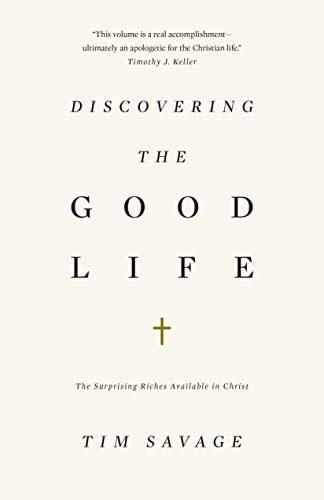
Content taken from Discovering the Adept Life by Timothy B. Savage, ©2019. Used by permission of Crossway, a publishing ministry building of Expert News Publishers, Wheaton, Il 60187, world wide web.crossway.org.
Tim Savage (PhD, University of Cambridge; ThM, Dallas Theological Seminary) is a pastor, writer, international briefing speaker, and founding council member of the Gospel Coalition. He has served in churches in Arizona, Great Britain, and Texas. He is married to Lesli and they have ii developed sons, Matthew and Jonathan. Tim is the author of No Ordinary Wedlock.
Source: https://gcdiscipleship.com/article-feed/2019/5/10/what-it-means-that-we-have-died-with-christ
0 Response to "what does it mean to die with christ?"
Post a Comment