How to Tell if Your Having a Big Baby
How mutual are big babies?
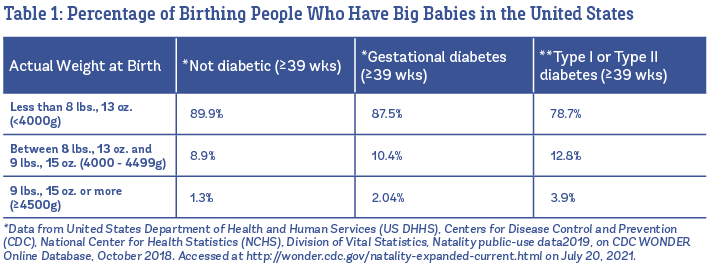
Almost ane in ten babies is built-in large in the U.s.a. (U.S.). Overall, 8.9% of all babies born at 39 weeks or afterwards weigh betwixt 8 lbs., 13 oz., and 9 lbs., 15 oz., and 1.3% are born weighing 9 lbs., xv oz. or more (U.Southward. Vital Statistics, 2019). In Table 1, y'all can see the percentages listed separately babies born to people who are non diabetic, vs. babies built-in to those with gestational diabetes and Type I or Type II diabetes.
What factors are linked to having large babies? Big babies run in families (this is influenced past genetics), and it'south more common to have a big baby when the baby's sexual practice is male person (Araujo Júnior et al. 2017). As y'all can see in Table one, people with diabetes before or during pregnancy have higher rates of big babies compared to people who are non-diabetic. Other factors that are linked to big babies include having a higher trunk mass index (BMI) before pregnancy, higher weight gain during pregnancy, older age, post term pregnancy, and a history of having a large baby (Araujo Júnior et al. 2017; Rui-Xue et al. 2019; Fang Fang et al. 2019).
Among people with gestational diabetes, researchers take found that having a higher blood sugar at first diagnosis makes y'all more likely to have a baby who is large for gestational age. (Metzger et al. 2008). However, pregnant people who manage their gestational diabetes through diet, practice, or medication can bring downwardly their chances of having a large baby to normal levels (or about 7%) (Landon et al. 2009).
In add-on, there is high quality show from 15 randomized trials showing that pregnant parents who exercise (both those with and without diabetes) have a pregnant decrease in the compared to those who do not do during pregnancy (Davenport et al. 2018).
What is routine care for suspected big babies?
The most detailed testify we have on typical care for large babies comes from the U.S. Listening to Mothers Iii Survey, which was published in the early 2010s. Although only 1 in 10 babies is built-in large, researchers found that 2 out of three families in the U.S. had an ultrasound at the end of pregnancy to determine their baby'southward size, and ane out of three families in the report were told that their babies were too big. In the cease, the average birth weight of their suspected "large babies" was but 7 lbs., 13 oz. (Declercq, Sakala et al. 2013).
Of the people who were told that their baby was getting large, two out of three said their care provider discussed inducing labor because of the suspected big baby, and one out of iii said their intendance provider talked virtually planning a Cesarean because of the large babe.
Most of the families whose care providers talked near induction for big babe concluded up being medically induced (67%), and the rest tried to self-induce labor with natural methods (37%). Virtually one in five survey respondents said they were not offered a choice when information technology came to consecration—in other words, they were told that they must be induced for their suspected big infant.
When care providers brought up planning a Cesarean for a suspected big baby, one in three families ended up having a planned Cesarean. 2 out of v survey respondents said that the discussion was framed equally if at that place were no other options—that they must have a Cesarean for their suspected big babe.
In the end, care provider concerns about a suspected big baby were the fourth most common reason for an induction (making up sixteen% of all inductions), and the fifth most common reason for a Cesarean (making upwardly 9% of all Cesareans). More than one-half of all birthing people (57%) believed that an induction was medically necessary if a care provider suspects a big baby.
So, in the U.S., most people have an ultrasound at the stop of pregnancy to gauge the baby'south size, and if the baby appears large, their care provider will ordinarily recommend either an consecration or an elective Cesarean. Is this approach evidence-based?
This approach is based on 5 major assumptions:
- Big babies have a higher risk of their shoulders getting stuck (also known as shoulder dystocia).
- Big babies are at higher risk for other birth problems.
- We tin accurately tell if a baby will exist big.
- Induction keeps the babe from getting whatsoever bigger, which lowers the adventure of Cesarean.
- Constituent Cesareans for big babe are but beneficial; that is, they don't take major risks that could outweigh the benefits.
Assumption #1: Big babies are at higher chance for getting their shoulders stuck (shoulder dystocia).
Reality #1: While it is truthful that 7-fifteen% of big babies have difficulty with the nascency of their shoulders, nearly of these cases are handled past the intendance provider without whatsoever harmful consequences for the baby. Permanent nerve injuries due to stuck shoulders happen in i out of every 555 babies who counterbalance between 8 lbs., 13 oz. and nine lbs., xv oz., and i out of every 175 babies who weigh nine lbs., 15 oz. or greater.
One of the main concerns with large babies is shoulder dystocia ("dis toh shah"). Shoulder dystocia is defined as when shoulders are stuck enough that the care provider has to have extra physical action(s), or maneuvers, to help become the baby out.
In the past, researchers have referred to shoulder dystocia every bit the "obstetrician'due south greatest nightmare" (Chauhan 2014). The fear with shoulder dystocia is that it is possible that the baby might non get enough oxygen if the head is out but the body does not come up out soon afterwards. There is also a run a risk that the babe volition experience a permanent nerve injury to the shoulders.
1 of the reasons that care providers have a fear of shoulder dystocia is because if the infant experiences an injury during or subsequently shoulder dystocia, this type of injury is a common cause of litigation. In a report carried out at the University of Michigan, researchers found that half of all parents whose children were being treated for shoulder dystocia-related injuries were pursuing litigation (Domino et al. 2014).
How frequently does shoulder dystocia occur? Researchers who combined results from ten studies found that shoulder dystocia happened to 6% of babies who weighed more than than four,000 grams (viii lbs., thirteen oz.) versus 0.half-dozen% of those who were not big babies (Beta et al. 2019). When babies weighed more than 4,500 grams (9 lbs., 15 oz.), 14% experienced shoulder dystocia.
Similarly, one high-quality study that looked separately at meaning people with and without diabetes showed that in non-diabetic people, shoulder dystocia happened to 0.65% of babies who weighed less than 8 lbs., xiii oz. (half dozen.5 cases out of one,000 births), 6.7% of babies who weighed betwixt eight lbs., xiii oz. and 9 lbs., fifteen oz. (sixty out of i,000), and 14.5% of babies who weighed 9 lbs., 15 oz. or greater (145 out of 1,000) (Rouse et al. 1996).
Rates of shoulder dystocia were much higher in large babies whose birthing parent had Type I and Type Two diabetes (2.2% of babies that weighed less than viii lbs., 13 oz., thirteen.9% of babies that weighed between 8 lb., 13 oz. and 9 lb., 15 oz., and 52.5% of babies that weighed more than than ix lb., 15 oz.) (Rouse et al. 1996).
We were not able to find exact numbers for the percentage of people with gestational diabetes who had a baby with shoulder dystocia, as the rates change depending on each person'south blood carbohydrate level. All the same, in that location is strong evidence that treatment for gestational diabetes drastically lowers the chance of having a big baby and shoulder dystocia. We cover the evidence on treatment for gestational diabetes (link evidencebasedbirth.com/inducingGDM) in our Evidence Based Birth® Signature Article on Induction for Gestational Diabetes.
It'southward interesting to annotation that people with high blood sugar levels during pregnancy are at increased chance of shoulder dystocia during birth even when the baby is not large. This is because weight can be distributed differently on a baby when their gestational carrier has loftier blood sugars. Bug are more likely to occur if the baby'south head size is relatively small compared to the size of its shoulders and belly (Kamana et al. 2015).
Although big babies are at higher adventure for shoulder dystocia, at least one-half of all cases of shoulder dystocia happen in smaller or normal sized babies (Morrison et al. 1992; Nath et al. 2015). This is considering overall, there are more minor and normal size babies born than big babies. In other words, the rate of shoulder dystocia is college in bigger babies, but the absolute numbers are nearly the aforementioned with bigger and smaller babies. Unfortunately, researchers accept found that information technology is incommunicable to predict exactly who will accept shoulder dystocia and who will not (Foster et al. 2011).
Considering at to the lowest degree half of shoulder dystocia cases occur in babies that are not big, and we tin't predict who volition have a shoulder dystocia, shoulder dystocia will always be a possibility during childbirth. That is, the risk tin only be eliminated if all babies are born past Cesarean. Because requiring everyone to take a Cesarean is unethical and impractical, it is important for health care providers to railroad train for the possibility of a shoulder dystocia.
Other resources on resolving shoulder dystocia:
- At that place are ways intendance providers tin help prevent and manage a shoulder dystocia. For more information, read this article on shoulder dystocia past Midwife Thinking.
- Click hither for a PowerPoint from a shoulder dystocia training course from the United kingdom.
- Spinning Babies offers an online continuing education course about resolving shoulder dystocia. You can too download a free PDF on the FLIP-FLOP technique for managing shoulder dystocia here.
- This video and this article describe how care providers can use a technique called the "shoulder shrug maneuver" to resolve shoulder dystocia (Sancetta et al. 2019).
- The Royal College of Obstetricians and Gynecologists has a guideline (last reviewed in 2017) on predicting, preventing, and managing shoulder dystocia here.
Brachial plexus palsy
A shoulder dystocia past itself is non considered a "bad result." Information technology'due south only a bad outcome if an injury occurs forth with the shoulder dystocia (Personal communication, Emilio Chavirez, Dr., FACOG, FSMFM). Although nearly cases of shoulder dystocia can be safely managed by a intendance provider during the birth, some can consequence in a nerve injury in the baby called brachial plexus palsy.
Brachial plexus palsy, which leads to weakness or paralysis of the arm, shoulder, or mitt, happens in about 1.iii out of every 1,000 vaginal births in the U.South. and other countries. A babe does not take to accept shoulder dystocia to experience a brachial plexus palsy—in fact, 48%-72% of brachial plexus palsy cases happen without shoulder dystocia. When a brachial plexus palsy happens at the same time as shoulder dystocia, however, it is more likely to cease up in a lawsuit than a brachial plexus palsy that did not occur with a shoulder dystocia (Chauhan et al. 2014).
Although rare, brachial plexus palsy can also happen to babies born past Cesarean. In one study that looked at 387 children who experienced brachial plexus palsy, 92% were born vaginally and 8% were born by Cesarean (Chang et al. 2016). Other researchers have found that brachial plexus palsy happens in most 3 per 10,000 Cesarean births (Chauhan et al. 2014).
Some infants who have a brachial plexus palsy (about 10%-18%) will finish up with a permanent injury, defined as arm or shoulder weakness that persists for more than a year after nascency. It'southward estimated that there are anywhere from 35,000 to 63,000 people living with permanent brachial plexus injuries in the U.Southward. (Chauhan et al. 2014). For a blog article about what information technology's similar to grow up with a brachial plexus palsy, read Nicola's story here.
In 2019, researchers combined five studies almost the risks of brachial plexus injury in pregnancies with babies over viii lbs., 13 oz. versus those with babies who were not large (Beta et al 2019). Big babies had significantly more brachial plexus injury (0.74% versus 0.06%). When babies weighed more than 4,500 grams (9 lbs., 15 oz.), the rate went up to i.9%.
In a recent written report of infants who were all extremely large at birth (>5000 grand, or >11 lbs.), 17 of 120 infants born vaginally had shoulder dystocia, and 3 of those 17 had temporary brachial plexus palsy that healed within vi months—for an overall charge per unit of about 1 brachial plexus palsy cases per 40 vaginally-born, extremely large babies (Hehir et al. 2015).
In 1996, Rouse et al. published rates of shoulder dystocia and brachial plexus palsy by infant weight. Using the numbers of permanent disability published by Chauhan et al. in 2014, we created a table that helps show the difference between the weight groups.

Importantly, research has shown that when wellness care professionals undergo almanac inter-professional person grooming (this means doctors, nurses, and midwives training together every bit a team) on how to handle shoulder dystocia, they can lower—and in some cases eliminate—brachial plexus palsy among babies who experience shoulder dystocia (Crofts et al. 2016). Doctors have been trying to have this successful grooming (called "PROMPT") from the Britain and implement it in the U.South. Results at the Academy of Kansas showed a decline and and then an eventual elimination of permanent cases of brachial plexus palsy with PROMPT annual trainings (Weiner et al. 2015).
To watch a news video nearly the PROMPT grooming, click here. To visit the PROMPT foundation website, clickhttps://www.promptmaternity.org/.
Can a baby die from shoulder dystocia?
Deaths from shoulder dystocia are possible but rare. In 1996, researchers looked at all the studies so far that had reported the charge per unit of death due to shoulder dystocia. In xv studies, at that place were 1,100 cases of shoulder dystocia and no deaths (a death rate of 0%). In two other studies, the rates of infant decease were 1% (one baby out of 101 "died at delivery," possibly due to the shoulder dystocia) and two.5% (one infant died out of 40 cases of shoulder dystocia) (Rouse et al. 1996).
In a written report published by Hoffman et al. in 2011, researchers looked at 132,098 people who gave birth at term to a live infant in head- first position. About i.5% of the babies had a shoulder dystocia (2,018 cases), and of those, 101 newborns were injured. Virtually of the injuries were brachial plexus palsy or collar bone fractures. Out of the 101 injured infants, there were zero deaths and six cases of brain impairment due to lack of oxygen. With the half-dozen brain-damaged infants, it took an boilerplate of 11 minutes between the birth of the head and the torso.
Supposition #2: Large babies can lead to a higher adventure of health bug and complications.
Reality #two: The risk of complications with a big baby increases forth a spectrum (lower risk at 8 lbs., thirteen oz., higher risk at 9 lbs., fifteen oz., and highest risk at 11+ lbs.). In addition, the care provider's "suspicion" of a big baby carries its ain set of risks.
Unplanned Cesareans
Researchers combined x studies (called a meta-analysis) and found that babies with nativity weights over 4,000 grams (8 lbs., 13 oz.) are more than likely to accept labors that end in Cesarean (Beta et al. 2019). In these studies, the average Cesarean rate was nineteen.3% for large babies versus 11.2% for babies who were not big. When babies weighed more than than 4,500 grams (9 lbs., 15 oz.), the Cesarean rate increased to 27%. As we will discuss, a care provider'south "suspicion" of a large baby can impact their likelihood of recommending Cesarean during labor.
Perineal Tears
In the meta-analysis published by Beta et al. (2019), v studies institute a meaning increment in the odds of severe tears with big babies, while iii studies did non find a deviation. When the researchers combined the results from all viii studies, the overall upshot showed that those who give nascency to large babies are more than likely to have severe perineal tears, also known equally 3rd or 4th degree tears. The gamble of a severe tear was 1.7% when birthing large babies versus 0.9% for birthing babies who were non big. When babies weighed more than 4,500 grams (ix lbs., 15 oz.), the rate of severe tears was 3%.
The largest study (over 350,000 pregnant participants from National Wellness Service hospitals) examined 3rd degree tears and found the rate to be 0.87% with big babies versus 0.45% without (Jolly et al. 2003). In this study, pregnancies with big babies were besides more than likely to have longer kickoff and second stages of labor and more utilize of vacuum and forceps. The increase in the utilize of vacuum and forceps among big babies likely contributed to the increase in severe tears.
The second largest written report, which included over 146,000 hospital births in California between 1995 and 1999, found a college rate of 4th caste tears in big babies who were built-in vaginally (Stotland et al. 2004). However, 4th degree tear rates in this study were very high, even amidst normal weight babies (ane.5%), and the authors did not depict how many birthing people had episiotomies, which is a leading cause of severe tears.
Although having a big baby may be a adventure factor for severe tears, it may be helpful to compare this risk to other situations that can also increase the risk of tears. For example, one large study found that the risk of a severe tear with a big babe ranged from 0.2% to 0.half dozen% (Weissmann-Brenner et al. 2012).Other researchers take found that a vacuum delivery increases the gamble of a astringent tear by xi times. So, if your baseline run a risk was 0.2%, it would increment to 2.2% with a vacuum, and the apply of forceps increases the gamble of a severe tear by 39 times (from 0.2% to seven.8%) (Sheiner et al. 2005).
Postpartum Hemorrhage
Researchers combined 9 studies that reported on postpartum hemorrhage in people who gave nativity to large babies compared to those who birthed babies who were non large (Beta et al. 2019). They found a college rate of hemorrhage with babies over 8 lbs., 13 oz. (iv.7% versus 2.3%). When the birth weights were over 4,500 grams (9 lbs., xv oz.), the rate of postpartum hemorrhage was 6%. However, information technology is not clear whether this higher rate of postpartum hemorrhage is due to the big babies themselves or the inductions and Cesareans that care providers often recommend for a suspected big baby (Fuchs et al. 2013)—every bit both these procedures tin increment the hazard of postpartum hemorrhage (Magann et al. 2005).
Newborn complications
One report compared 2,766 big babies with the same number of babies with normal birth weights. All babies in the study were born to not-diabetic parents (Linder et al. The researchers found that big babies were more likely to take low blood sugar after nascency (1.2% vs. 0.5%), temporary rapid breathing (also known as "transient tachypnea" or "wet lung," one.5% vs. 0.five%), high temperature (0.6% vs. 0.1%), and birth trauma (ii% vs. 0.vii%).
The researchers did not say whether care providers suspected that the babies were big earlier labor began, or if their care was managed differently. More than of the large infants in this study were born past Cesarean (33% vs. 15%), which could have played a function in the higher rates of breathing problems, since breathing bug are more common with Cesarean-built-in babies.
Nascency fractures, or broken collar bones or arms, are rare but more likely to occur amidst big babies. Researchers combined the results from five studies and found that the rate of nativity fractures among babies over four,000 grams (8 lbs., 13 oz.) was 0.54% versus 0.08% amid babies who are non large (Beta et al. 2019). When babies weighed more than four,500 grams (9 lbs., 15 oz.), the fracture charge per unit was increased to one.01%.
Stillbirth
Some doctors recommend Cesareans for suspected large babies because they believe in that location is a higher take chances of stillbirth.
In 2014, researchers published a written report where they looked dorsum in time at 784,576 births that took place in Scotland between the years 1992 and 2008. They included all babies who were born at term or mail-term (between 37 and 43 weeks). They did not include multiples or any babies who died from congenital anomalies (Moraitis et al. 2014).
Babies in this study were grouped according to their size for gestational age—4th to tenth percentile, 11th to 20th percentile, 21st to 80th percentile (considered the normal grouping), 81st to 90th percentile, 91st to 97th percentile, and 98th to 100th percentile. The gestational age of each baby was confirmed by ultrasounds that took place in the first half of pregnancy.
In this report, there were 1,157 stillbirths, and the adventure of stillbirth was highest in the groups with the smallest babies (1st to tertiary and 4th to tenth percentiles). The third highest risk of stillbirth death was seen in the babies who were in the 98th to 100th percentiles for weight (extremely large for gestational age). Using the American Academy of Pediatrics growth curve for gestational age, the 98th to 100th percentiles would exist roughly equivalent to a baby who is born weighing 9 lbs., 15 oz. or greater at 41 weeks.
Meanwhile, the everyman rates of stillbirth were in babies who were in the 91st to 97th percentiles. The increase in stillbirth gamble in the largest group (98th to 100th percentile) was partly explained by the birth parent being diabetic; notwithstanding, there was also a higher risk of unexplained stillbirth for babies in the 98th to 100th percentile. Overall, the absolute run a risk of an extremely large for gestational age baby (98th to 100th percentile) experiencing stillbirth between 37 and 43 weeks was about 1 in 500, compared to 1 in ane,000 for babies who are in the 91st to 97th percentile.
Another report on this topic looked back in time at 693,186 births and 3,275 stillbirths between 1992-2009 in Alberta, Canada (Wood and Tang, 2018). They included all babies born at ≥23 weeks just did non include multiples.
This big Canadian database study establish several take chances factors for stillbirth: giving nascence for the first fourth dimension, having higher body mass index (BMI), smoking in pregnancy, older age, and having medical problems before pregnancy such as high blood pressure and diabetes. Like the previous study, small for gestational age was a strong risk factor for stillbirth. Simply babies who were large for gestational age were non at any increased risk for stillbirth. In fact, being big for gestational age was protective against stillbirth in the general population.
However, when researchers looked specifically at birth parents with gestational diabetes, being large for gestational age was linked with a higher risk of stillbirth. The same was true for birth parents with Type I or Type II diabetes.
The hazard of stillbirth has historically been higher in pregnant people with Type I or Type II diabetes. However, in recent years the stillbirth rate for those with Type I or Blazon Two diabetes has drastically declined due to improvements in how diabetes is managed during pregnancy (Gabbe et al. 2012). As far as gestational diabetes goes, the largest study ever done on gestational diabetes constitute no link between gestational diabetes and stillbirth (Metzger et al. 2008). In the Canadian written report, gestational diabetes was not linked with a higher risk of stillbirth unless the babe was too considered to be large for gestational historic period.
In 2019, a large study in the U.S. analyzed medical records of stillbirths that occurred betwixt 1982 and 2017. The purpose of this report was to look at the possible relationship between big babies and stillbirth, simply other factors were likewise considered (Salihu et al. 2014). It is important to note that overall, the rates of stillbirth have declined dramatically in both big and normal-sized babies over the final 4 decades. The pass up in stillbirths may be due to advancements in medical preparation and pregnancy screening. In this written report population, the charge per unit of stillbirth in big babies declined 48.five% (from 2.04 per i,000 to 1.1 per k), and it likewise declined 57.4% in babies of normal size (from one.95 per i,000 to 0.83 per 1000).
In total, more than 100 million pregnancies were analyzed in this written report. About x% of the full number of pregnancies were big babies. In the big baby group, there were 1.two stillbirths per 1,000 pregnancies, compared to i.1 stillbirths per 1,000 pregnancies in the normal nascence weight range.
The researchers point out that the run a risk of a large baby being stillborn varies from state of affairs to situation, and and then intendance should be individualized. In other words, not all big babies carry the same level of potential hazard when it comes to the chances of stillbirth. In their report, researchers separated the babies into three groups (form i or 4000-4499 grams, grade 2 or 4500-5000 grams, and grade 3 or over 5000 grams). Babies in the class 3 group experienced an 11-fold increase in stillbirth (eleven stillbirths per one,000 pregnancies) when compared to babies in the grade ane grouping (1 stillbirth per 1,000 pregnancies). However, class 3 big babies made up only one.5% of the total big baby grouping, while form ane big babies made upwardly more than 85% of the full big baby group. Overall, the group with the highest run a risk of stillbirth was the low birthweight group (fourteen.89 stillbirths per 1,000 pregnancies). The second highest rate of stillbirth was in the grade 3 big babe grouping. Some strengths of this report are the big data set and the classification of large babies into grades of macrosomia. A limitation is that because of the way the information was collected, we don't know if significant people who were diagnosed with "diabetes" had gestational diabetes or pre-existing Blazon one or Type 2 diabetes.
Is it Harmful to Suspect a Big Infant?
When a large baby is suspected, families are more likely to experience a change in how their care providers see and manage labor and birth. This leads to a college Cesarean rate and a college rate of people inaccurately being told that labor is taking "likewise long" or the infant "doesn't fit."
In fact, research has consistently shown that the intendance provider'southward perception that a baby is large can be more harmful than an actual big baby by itself.
have all shown that it is the suspicion of a big baby—not big babies themselves—that can lead to college induction rates, higher Cesarean rates, and higher diagnoses of stalled labor (Levine et al. 1992; Weeks et al. 1995; Parry et al. 2000; Weiner et al. 2002; Sadeh-Mestechkin et al. 2008; Blackwell et al. 2009; Melamed et al. 2010; Fiddling et al. 2012; Peleg et al. 2015).
In one report, researchers compared what happened when people were suspected of being pregnant with a big babe (>eight lbs., 13 oz.) versus people who were not suspected of beingness pregnant with a large baby—but who ended up having one (Sadeh-Mestechkin et al. 2008).
The end results were amazing. Birthing people who were suspected of having a big baby (and actually concluded upwardly having i) had triple the induction rate, more than triple the Cesarean rate, and a quadrupling of the maternal complication rate, compared to those who were non suspected of having a big baby but had 1 anyway.
Complications were most often due to Cesareans and included bleeding (hemorrhage), wound infection, wound separation, fever, and need for antibiotics. There were no differences in shoulder dystocia betwixt the two groups. In other words, when a intendance provider "suspected" a big baby (equally compared to not knowing the baby was going to be big), this tripled the Cesarean rates and made mothers more likely to experience complications, without affecting the rate of shoulder dystocia (Sadeh-Mestechkin et al. 2008).
These results were supported by another written report published by Peleg et al. in 2015. At their infirmary, physicians had a policy to counsel everyone with suspected big babies (suspected of being eight lbs., 13 oz. and college, or ≥four,000 grams) about the "risks" of big babies. Elective Cesareans were not encouraged, but they were performed if the family unit requested 1 after the word. At that place were 238 participants who had suspected big babies (that concluded up truly beingness large at birth) and were counseled, and 205 participants who had unsuspected big babies (that concluded upwards existence truly large at birth) who were not counseled.
Even though the babies were all nigh the same size, but 52% of participants in the suspected large baby group had a vaginal birth, compared to 91% of participants in the non-suspected big infant grouping. This increment in Cesarean charge per unit in the suspected big baby group was primarily due to an increase in the families requesting constituent Cesareans after the "counseling" session about how large babies are risky to birth. In that location was only ane case of shoulder dystocia in the unsuspected big infant group, and 2 cases in the suspected big baby group. None of these babies experienced injuries. In that location was no difference in severe birth injuries between the two groups.
The authors ended that obstetricians should not be counseling pregnant people nearly the risks of big babies thought to be 8 lbs. thirteen oz. or college, because it leads to an increase in the number of unnecessary Cesareans without any benefit to the birthing person or baby. They suggested that researchers should study using a higher weight cutting-off (such as ix lbs., xv oz.) to trigger counseling.
Other researchers have constitute that when a first-time parent is incorrectly suspected of having a big baby, intendance providers have less patience with labor and are more likely to recommend a Cesarean for stalled labor. In this report, researchers followed 340 showtime-time birthing people who were all induced at term. They compared the ultrasound judge of the baby'due south weight with the actual birth weight. When the ultrasound incorrectly said the infant was going to weigh more than 15% higher than it ended up weighing at birth, physicians were more than twice as likely to diagnose "stalled labor" and perform a Cesarean for that reason (35%) than if in that location was no overestimation of weight (13%) (Blackwell et al. 2009b).
Pregnant people who are plus size and those who take medication for loftier claret saccharide too feel an increase in unplanned Cesareans when ultrasound is used to gauge the baby's weight (Dude et al. 2019; Dude et al. 2018).
A contempo study from the U.South. looked at 2,826 first-time birthing people with a body mass index (BMI) ≥ 35 kg/g2 (Dude et al. 2019). Out of everyone in the written report, 23% had an ultrasound to gauge the baby's weight inside 35 days of birth. The participants who had an ultrasound to estimate the baby'due south weight were more than probable to have an unplanned Cesarean (mostly for "stalled labor") than those without an ultrasound-estimated fetal weight (43% versus xxx%). Having an ultrasound to estimate the baby's weight was linked with a higher charge per unit of Cesarean even after considering other factors that could have impacted the Cesarean charge per unit, including the infant's actual nascency weight.
Amid the 636 participants who had an ultrasound to gauge the baby's weight, 143 of them were told that their babies were large for gestational age (measuring over the ninetythursday percentile). This group had a much higher rate of Cesarean (61% versus 31%). However, only 44% of them (61 out of the 143 birthing people) gave birth to a infant that was large for gestational age.
The authors found similar results when they looked at around 300 people who were giving birth for the first time and taking medication for high claret saccharide (Dude et al. 2018). Again, having an ultrasound to guess the baby's weight inside 35 days of birth was linked to a college rate of unplanned Cesareans (52% for those with an ultrasound versus 27% for those without an ultrasound) even subsequently considering the infant's actual birth weight and other medical factors.
The authors conclude, "Perceived cognition of fetal weight may bear upon decisions providers make regarding how likely they experience their patients are to deliver vaginally."
It's not surprising that physicians are more likely to turn to Cesarean in these situations, given a cultural fear of big babies. In i medical periodical editorial, an obstetrician with a articulate bias towards Cesarean for big babies said that, "Flagging up all cases of predicted fetal macrosomia is vitally important, so that the attendants in the labor suite volition recommend Cesarean if there is any delay in cervical dilatation or arrest of caput rotation or descent. Cesarean should also be the preferred option if an abnormal fetal heart tracing develops" (Campbell, 2014).
And so, in summary, although large babies are at higher hazard for some bug, the care provider's perception that there is a big baby carries its own fix of risks. This perception—whether it is true or false—changes the way the care provider behaves and how they talk to families well-nigh their power to birth their baby, which, in plow, increases the chance of Cesarean.
Assumption #iii: We tin can tell which babies volition be big at birth.
Reality #3: Both concrete exams and ultrasounds are equally bad at predicting whether a baby will be big at birth.
Time and time again, researchers have found that it is very difficult to predict a infant'due south size before it is born. Although 2 out of three people giving nativity in the U.Due south. receive an ultrasound at the end of pregnancy (Declercq et al. 2013) to "judge the baby's size," both the care provider's estimate of the baby'south size and ultrasound results are unreliable.
In 2005, researchers looked at all the studies that had ever been done on ultrasound and estimating the baby's weight at the end of pregnancy. They establish 14 studies that looked at ultrasound and its ability to predict that a baby would weigh more than eight lbs., 13 oz. Ultrasound was accurate fifteen% to 79% of the time, with about studies showing that the accuracy ("mail service-test probability") was less than l%. This means that for every 10 babies that ultrasound predicts will counterbalance more eight lbs., 13 oz., five babies will weigh more than than that and the other five will weigh less (Chauhan et al. 2005).
Ultrasound was even less authentic at predicting babies who volition be built-in weighing 9 lbs., 15 oz. or greater. In three studies that were washed, the accuracy of ultrasounds to predict extra-large babies was merely 22% to 37%. This means that for every 10 babies the ultrasound identified as weighing more than nine lbs., 15 oz., only two to four babies weighed more than this amount at birth, while the other half-dozen to eight babies weighed less (Chauhan et al. 2005).
The researchers found iii studies that looked at the power of ultrasound to predict big babies in pregnant people with diabetes. The accuracy of these ultrasounds was 44% to 81%, which means that for every ten babies of a diabetic parent who are thought to weigh more than than 8 lbs., 13 oz., around half dozen will counterbalance more than and four will counterbalance less. The ultrasound test probably performs better in diabetics simply because diabetics are more than probable to have big babies. In other words, information technology'due south easier to predict a big baby in someone who is much more likely to have a big babe to begin with.
Currently, in that location is no reason to believe that three-dimensional (3D) ultrasound is whatsoever better at predicting nascency weight and big babies than two-dimensional (2nd) ultrasound (Tuuli et al. 2016). Research is ongoing to make up one's mind if 3D measurements can be combined with second measurements to ameliorate predict macrosomia.
At that place is also no evidence that magnetic resonance imaging (MRI) improves the accuracy of fetal weight estimates. The showtime prospective clinical written report to compare estimated fetal weight from 2nd ultrasound versus MRI is currently being conducted in Belgium (Kadji et al. 2019). The researchers call back that MRI at 36 to 37 weeks of pregnancy could be much more accurate than ultrasound at predicting big babies. However, even if MRI is found to be superior, information technology is very expensive and probably not practical.
Compared to using ultrasound, care providers are just as inaccurate when it comes to using a concrete exam to gauge the size of the baby. However, ultrasound appears to provide more than authentic estimates when pregnant people are plus size (Preyer et al. 2019).
Overall, when a care provider estimates that a baby is going to counterbalance more than 8 lbs., 13 oz., the accuracy is simply 40-53% (Chauhan et al. 2005). This means that out of all the babies that are thought to weigh more than than 8 lbs., 13 oz., one-half volition weigh more viii lbs., xiii oz. and one-half will weigh less.
The care provider's accuracy goes upward if the pregnant person has diabetes or is post-term, again, probably considering the chance of having a big baby is higher amidst these groups. Unfortunately, all the studies that looked at diabetes and the accuracy of ultrasound lumped people with gestational diabetes and those with Type I or Blazon II diabetes into the same groups, limiting our ability to interpret these results.
A systematic review concluded that there is "no articulate consensus with regard to the prenatal identification, prediction, and management of macrosomia." The authors stated that the main trouble with big babies is that it is very hard to diagnose big babies before birth—information technology'southward a diagnosis that can only be made later on birth (Rossi et al. 2013).
Even the "best" way to predict a big babe is going to have problems identifying bodily large babies—almost often overestimating the size of the baby. In a 2010 written report past Rosati et al., researchers tested different ultrasound "formulas" to figure out an infant'southward estimated weight. The best formula for predicting nativity weight was the "Warsof2" formula, which is based solely on the baby's intestinal measurement. The results of this formula came within ±15% of the baby's bodily weight in 98% of cases. As an example, if your infant's actual weight was 8 lbs. (3,629 grams), the ultrasound could estimate the baby's weight to be anywhere between half-dozen lbs., 13 oz. (3,090 grams) and ix lbs., three oz. (four,450 grams).
Many weight interpretation formulas have been published (new second and 3D formulas are added every year), and researchers keep to debate whether they are accurate.
Recently, a report compared the "Hart" weight estimation formula to the "Hadlock" formula (Weiss et al. 2018). The "Hadlock" formula is very popular today and considered by many to be the about accurate (Milner and Arezina, 2018). Weiss et al. plant that compared to the "Hadlock" formula, the "Hart" formula profoundly overestimated fetal weight when babies weighed less than 8 lbs., 13 oz. (four,000 grams) and failed to detect very large babies. The authors expressed concern that using the "Hart" formula could lead to an increased rate of labor induction and Cesareans, and they ended that information technology has no place in clinical practice.
Assumption #4: Consecration allows the infant to be born at a smaller weight, which helps avert shoulder dystocia and lowers the risk of Cesarean.
Reality #4: There is conflicting evidence about whether consecration for suspected big babies can improve health outcomes.
We will talk virtually three main pieces of evidence in this department:
- A 2016 Cochrane review (when researchers combined multiple randomized trials together)
- The largest study (published in 2015) from the Cochrane review
- The second-largest study (published in 1997) from the Cochrane review
Cochrane Review
In a 2016 Cochrane review, researchers (Boulvain et al. 2016) combined four studies in which one,190 non-diabetic significant people with suspected large babies were randomly assigned (like flipping a coin) to either ane) induction between 37 and twoscore weeks or 2) waiting for spontaneous labor.
When researchers compared the induction group to the waiting grouping, they found a decrease in the rate of shoulder dystocia in the induction group—nearly 41 cases per 1,000 births in the constituent induction group, down from 68 cases per 1,000 in the waiting grouping.
They also found a decrease in nascence fractures in the constituent induction group (4 per 1,000 vs. 20 per ane,000 in the waiting group). To prevent one fracture, it would be necessary to induce labor in 60 people.
On the other paw, they institute an increase in astringent perineal tears in the induction grouping (26 per 1,000 in the induction group vs. 7 per 1,000 in the waiting grouping), also as an increase in the treatment of jaundice (11% vs. seven%).
On average, babies weighed 178 grams (half dozen ounces) less when labor was electively induced, compared with those assigned to expect for labor.
There were no differences between groups in rates of Cesarean, instrumental delivery, NICU admissions, brachial plexus palsy, or low Apgar scores. Three of the four studies reported death rates, and there were zero deaths in either group.
Researchers did not expect at patients' satisfaction with their care or any long-term wellness results for birthing people or babies.
Largest study in Cochrane review (2015)
The study published by Boulvain et al. 2015 was the largest written report in the Cochrane review. In this study, researchers followed 818 significant people with suspected large babies who were randomly assigned to either a) induce labor between 37 to 38 weeks, or b) await for labor to start on its ain until 41 weeks. This is the largest randomized trial that has always been done on induction for suspected big babies.
Pregnant people could be in the study if they had a single baby in caput-downward position, whose estimated weight was in the 95th percentile (>seven lbs., xi oz. at 36 weeks, 8 lbs., 3 oz. at 37 weeks, or 8 lbs., 10 oz. at 38 weeks). About ten% of the participants in this study had gestational diabetes.
There was some cantankerous-over between groups: 11% of participants in the consecration group went into labor on their own, and 28% of participants in the waiting-for-labor grouping were induced.
The researchers found that pregnant people randomly assigned to the induction group (whether or not they were actually induced) had fewer cases of shoulder dystocia: one% of people in the induction group (five out of 407) had truthful shoulder dystocia compared with 4% (16 out of 411) of those in the expectant direction grouping. None of the babies in either group experienced any brachial plexus palsy injuries, and collarbone fracture rates were low in both groups (i to 2%).
The chances of having a spontaneous vaginal birth was slightly more common in the consecration group (59% vs. 52%), only in that location was no difference in the rates of Cesarean and the apply of forceps or vacuum. There were no other differences in birth outcomes, including whatsoever tears or hemorrhage.
The infants in the induction grouping were more likely to have jaundice (9% vs. 3%) and receive phototherapy treatment (xi% vs. 7%). In that location were no differences in NICU admission rates or any other newborn differences betwixt groups.
In summary, this report institute that early induction (at 37-38 weeks) lowered the rate of shoulder dystocia, but without whatsoever accompanying impact on bodily brachial plexus palsy rates, collarbone fractures, or NICU admissions.
The authors suggested that the main reason they found dissimilar results from an earlier randomized trial by Gonen et al. (1997), is considering they checked fetal weight earlier and induced babies earlier— between 37 to 39 weeks, instead of waiting until 38 to 39 weeks. This meant that they induced labor when a fetus is large for gestational age, just earlier it was technically "big," resulting in the nascence of a normally sized baby a few weeks early. For case, in the Gonen et al. study discussed next, pregnant people were not included in the written report until they were at least 38 weeks meaning and their estimated fetal weight reached 8 lbs., 13 oz. Meanwhile, in the newer trail by Boulvain et al., of the 411 infants in the waiting-for-labor grouping, 62% weighed more than 4000 k (8 lbs., xiii oz.) at birth, compared with 31% of those who were induced. This ways that the participants who waited for labor to start on its ain ended up with big babies, while those who were induced early gave nascence before their babies could become large.
The authors of the Boulvain study retrieve that previous studies have not constitute a benefit to induction because providers waited as well long to intervene, and they missed their chance for the female parent to nativity a smaller baby and reduce the adventure of shoulder dystocia. Although this approach—inducing labor between 37 and 39 weeks—resulted in lower rates of shoulder dystocia, it also led to college rates of newborn jaundice, and it did not take whatever impact on "hard" outcomes such as brachial plexus palsy or NICU admission.
2nd-largest written report in the Cochrane Review
The Gonen et al. (1997) study was the 2nd-largest study in the Cochrane review (with 273 participants). In this study, pregnant people were included if they were at to the lowest degree 38 weeks, had a suspected big baby (8 lbs., 13 oz. to ix lbs., 15 oz.), did not accept gestational diabetes, and had not had a previous Cesarean. Less than half the participants were giving birth for the first time. Participants were randomly assigned to either immediate induction with oxytocin (sometimes also with cervical ripening) or waiting for spontaneous labor.
The results? Participants in the spontaneous labor grouping went into labor nearly 5 days later than those who were immediately induced. Although participants in the spontaneous labor group tended to have slightly bigger babies (on boilerplate, 3.5 oz. or 99 grams heavier), there was no difference in shoulder dystocia or Cesarean rates. All 11 cases of shoulder dystocia, spread beyond both groups, were hands managed without any nerve damage or trauma. Two infants in the waiting-for-labor group had temporary and mild brachial plexus palsy, just neither of these ii infants had shoulder dystocia. Finally, ultrasound overestimated the babe's weight 70% of the time and nether-estimated the babe'due south weight 28% of the time.
In summary, the researchers institute that: 1) ultrasound interpretation of weight was inaccurate, two) shoulder dystocia and nerve injury were unpredictable, and 3) induction for large babe did not subtract the Cesarean charge per unit or the risk of shoulder dystocia.
Assumption #5: Elective Cesarean for big babe has benefits that outweigh the potential harms.
Reality #5: No researchers have always carried out a written report to decide the effects of constituent Cesareans for suspected large babies.
Although some care providers will recommend an induction for a big infant, many skip this step and go direct to recommending an elective Cesarean. However, researchers have estimated that this blazon of approach is extremely expensive and that it would accept thousands of unnecessary Cesareans to prevent ane case of permanent brachial plexus palsy.
In 1996, an important analysis published in the Periodical of the American Medical Clan proposed that a policy of elective Cesareans for all suspected big babies was not cost-constructive and that there were more potential harms than potential benefits (Rouse et al. 1996).
In this analysis, the researchers calculated the potential furnishings of 3 different types of policies:
- No routine ultrasounds to estimate the babies' sizes
- Routine ultrasounds, then elective Cesarean for babies weighing 8 lbs., 13 oz. or more
- Routine ultrasounds, then elective Cesarean for babies weighing 9 lbs., xv oz. or more
The researchers looked at the results separately for diabetic and non-diabetic people. Unfortunately, most research up to this fourth dimension bespeak did not distinguish between Type 1 or Type Two diabetes and gestational diabetes. Then the term "diabetic" could refer to all three types.
Among non-diabetics, a policy of constituent Cesarean for all suspected big babies over 8 lbs., 13 oz. ways that a large number of significant people and babies would feel unnecessary surgeries. In order to prevent one permanent brachial plexus palsy in babies suspected to be over 8 lbs., 13 oz., 2,345 people would have unnecessary Cesareans at a cost of $iv.9 million dollars per injury prevented (costs were estimated using year 1995 dollars).
With a policy of elective Cesareans for all suspected big babies over ix lbs., fifteen oz., even more than pregnant people would have surgeries found to be unnecessary in retrospect, considering ultrasounds are fifty-fifty less accurate in higher suspected weight ranges (Chauhan et al. 2005). In lodge to foreclose one permanent brachial plexus palsy in babies suspected to be over nine lbs., 15 oz., three,695 people would need to undergo unnecessary Cesareans at a cost of $viii.7 meg per injury prevented.
Such policies would increment rates of known risks from Cesarean, like serious infections, blood jell disorders, postpartum bleeding (hemorrhage) requiring blood transfusions, and newborn animate bug (run into "" from ChildbirthConnection.org).
Among diabetics, the results were different—by and large because ultrasound is slightly more reliable at predicting big babies in pregnant people who are diabetic, and considering shoulder dystocia is more mutual in this group as well. If pregnant diabeticswere offered an constituent Cesarean for every babe that is suspected of weighing more than 8 lbs., 13 oz., it would take 489 unnecessary surgeries to prevent ane example of permanent nervus damage, at a cost of $930,000 per injury avoided. If diabetics had elective Cesareans when their babies were suspected of existence 9 lbs., 15 oz. or greater, it would take 443 unnecessary surgeries to foreclose 1 example of permanent brachial plexus palsy, at a cost of $880,000 per injury avoided.
Please annotation: A price-effectiveness analysis is only equally good as its assumptions–the numbers that they use to plug into the analysis. For example, how did they determine how frequently shoulder dystocia occurs, the accuracy of ultrasounds, and how many permanent injuries occur? In the Rouse et al. (1996) paper, the authors did a very high-quality literature review to determine these factors. One drawback of this analysis is that the costs they reported did not include the price of lawsuits.
Some other of import drawback is that this assay is now over 20 years sometime.
Since the landmark Rouse et al. paper was published, two newer toll-effectiveness analyses have been published. However, both of these newer papers had major problems—one of them did not take into account the inaccuracy of ultrasound (Herbst, 2005), and the other researchers had a poor-quality systematic review—using numbers in their assumptions that overestimate the accuracy of ultrasound (Culligan et al. 2005). Because the researchers did non do a good chore of making their assumptions, we cannot trust the results of their analyses, and then their results are not included in this Signature Article.
In summary, evidence does not support elective Cesareans for all suspected big babies, especially amidst non-diabetic significant people. There have been no randomized, controlled trials testing this intervention for big babies, and no high-quality research studies to see what happens when this intervention is used on a mass-calibration in real life.
In fact, significant people without diabetes may be given 1-sided information past their care providers if elective Cesarean is presented as a completely "safe" or "safer" choice than vaginal birth for a suspected big baby. Although vaginal birth with a large baby carries risks, Cesarean surgery also carries potential harms for the birthing person, infant, and any children born in futurity pregnancies. It is of import to have total information on both options in order to make a determination. To read more than about the potential benefits and harms of Cesarean versus vaginal birth, you lot may desire to read: "Vaginal or Cesarean Nascency: What is at Stake for Women and Babies?" or the consumer booklet, "What every woman should know about Cesarean Department" from Childbirth Connection.
Guidelines
In 2016, the American Congress of Obstetricians and Gynecologists (ACOG) released an opinion stating that induction is non recommended for suspected big babies, because consecration does not improve outcomes for birthing people or babies (recommendation based on "Level B evidence = express or inconsistent testify"). The 2016 exercise bulletin was reaffirmed by ACOG in 2018. This recommendation is similar to their 2002 guidelines that were reaffirmed in 2008 and 2015, and eventually replaced by this new position statement published in 2016. In 2020, ACOG released some other practice message stating that more inquiry needs to be done to determine whether the potential benefits of inducing for a suspected big baby to prevent shoulder dystocia earlier 39 weeks outweigh the risks of early consecration (ACOG, 2020).
In 2008, the National Institutes for Health and Clinical Excellence (NICE) in the Uk as well An updated recommendation from Squeamish, released as a draft in May 2021, suggests that all pregnant people should be offered induction at 41 weeks, rather than allowing babies to grow for up to 42 weeks, to lower possible complications. This advice is non specific to suspected big babies and is based on good opinion not clinical trials.
French practice guidelines from 2016 recommend induction for suspected large baby if the cervix is favorable at 39 weeks of pregnancy or more (Sentilhes et al. 2016). This recommendation is based on "professional consensus," not enquiry prove.
In all their opinion statements since 2002, ACOG has stated that planned Cesarean to preclude shoulder dystocia may be considered for suspected large babies with estimated fetal weights more than xi lbs. (5,000 grams) in birthing people without diabetes, and 9 lbs., 15 oz. (4,500 grams) in birthing people with diabetes.. They state the evidence is "Class C," meaning this recommendation is based on consensus and practiced stance only, non research show (ACOG 2002; ACOG 2013; ACOG 2016—Reaffirmed French guidelines on elective Cesarean for suspected large babe are consistent with the ACOG recommendation.
Source: https://evidencebasedbirth.com/evidence-for-induction-or-c-section-for-big-baby/
0 Response to "How to Tell if Your Having a Big Baby"
Post a Comment