Groom and Family Members Die in Vietnam Crash


Ii major war memorials commemorating the expressionless soldiers in the Second Indochina War (a.grand.a. the Vietnam War).
Estimates of casualties of the Vietnam War vary widely. Estimates include both noncombatant and military deaths in North and Southward Vietnam, Laos, and Cambodia.
The war persisted from 1955 to 1975 and about of the fighting took place in S Vietnam; accordingly it suffered the most casualties. The state of war also spilled over into the neighboring countries of Cambodia and Laos which too endured casualties from aerial and ground fighting.
Civilian deaths acquired by both sides amounted to a significant percentage of full deaths. Civilian deaths were partly acquired by assassinations, massacres, and terror tactics. Noncombatant deaths were also acquired past mortar and artillery, extensive aeriform bombing and the use of firepower in military machine operations conducted in heavily populated areas. A number of incidents occurred during the war in which civilians were deliberately targeted or killed. The near prominent of these events were the Huế Massacre and the Mỹ Lai Massacre.
Total number of deaths [edit]

Estimates of the total number of deaths in the Vietnam War vary widely. The broad disparity amongst the estimates cited below is partially explained past the different fourth dimension periods of the Vietnam War covered by the studies and whether casualties in Cambodia and Laos were included in the estimates.
A 1975 US Senate subcommittee estimated around 1.4 million civilian casualties in South Vietnam because of the state of war, including 415,000 deaths. An estimate by the Department of Defense after the war gave a figure of 1.2 million civilian casualties, including 195,000 deaths.[1] According to statistics from the South Vietnamese Ministry of Health, 44.5% of civilians admitted to hospitals betwixt 1967 and 1970 were wounded by mines or mortars, 21.2% by guns or grenades, and 34.3% by artillery or bombing.[two]
Guenter Lewy in 1978 estimated 1,353,000 full deaths in North and South Vietnam during the period 1965–1974 in which the U.Due south. was most engaged in the state of war. Lewy reduced the number of Viet Cong (VC) and People's Army of Vietnam (PAVN) boxing deaths claimed by the U.Southward. by 30 percentage (in accordance with the opinion of United states Section of Defence force officials), and assumed that ane third of the reported battle deaths of the PAVN/VC may have really been civilians. He estimates that between 30 and 46% of the total state of war deaths were civilians. His estimate of total deaths is reflected in the table.[3]
| US and centrolineal military machine deaths | 282,000 |
|---|---|
| PAVN/VC military deaths | 444,000–666,000 |
| Noncombatant deaths (North and Due south Vietnam) | 405,000–627,000 |
| Total deaths | 1,353,000 |
A 1995 demographic study in Population and Development Review calculated 791,000–i,141,000 war-related Vietnamese deaths, both soldiers and civilians, for all of Vietnam from 1965–75. The report came upwardly with a almost likely Vietnamese death toll of 882,000, which included 655,000 developed males (above 15 years of age), 143,000 adult females, and 84,000 children. Those totals include only Vietnamese deaths, and do not include American and other allied military deaths which amounted to about 64,000. The study's authors stated that methodological limitations of the written report include imbalance between rural and urban areas and the potential exclusion of high mortality areas.[iv] Another potential limitation is the relatively pocket-size sample size of the study.[5]
In 1995, the Vietnamese government released its guess of war deaths for the more than lengthy menstruum of 1955–75. PAVN and VC losses were reported as 1.one million expressionless and civilian deaths of Vietnamese on both sides totaled 2.0 million. These estimates probably include deaths of Vietnamese soldiers in Laos and Kingdom of cambodia, but do not include deaths of S Vietnamese and allied soldiers which would add nearly 300,000 for a g full of iii.four 1000000 military and civilian dead.[6]
A 2008 study by the BMJ (formerly British Medical Periodical) came up with a higher toll of 3,812,000 expressionless in Vietnam between 1955–2002. For the menses of the Vietnam War the totals are 1,310,000 between 1955 and 1964, one,700,000 between 1965–74 and 810,000 betwixt 1975 and 1984. (The estimates for 1955–64 are much college than other estimates). The sum of those totals is 3,091,000 war deaths betwixt 1955–75.[five]
Uppsala University in Sweden maintains the Armed Conflict Database. Their estimates for conflict deaths in Vietnam are 164,923 from 1955–64 and 1,458,050 from 1965–75 for a total of 1,622,973. The database also estimates combat deaths in Cambodia for the years 1967–75 to full 259,000. Data for deaths in Laos is incomplete.[seven]
R. J. Rummel'south mid-range approximate in 1997 was that the total deaths due to the Vietnam State of war totaled 2,450,000 from 1954–75. Rummel calculated PAVN/VC deaths at 1,062,000 and ARVN and allied state of war deaths of 741,000, with both totals including civilians inadvertently killed. He estimated that victims of democide (deliberate killing of civilians) included 214,000 by North Vietnam/VC and 98,000 by Due south Vietnam and its allies. Deaths in Cambodia and Laos were estimated at 273,000 and 62,000 respectively.[8]
| Depression guess of deaths | Middle approximate of deaths | Loftier estimate of deaths | Notes and comments | |
|---|---|---|---|---|
| North Vietnam/Viet Cong military and civilian war dead | 533,000 | one,062,000 | 1,489,000 | includes an estimated fifty,000/65,000/lxx,000 civilians killed by U.South/SVN bombing/shelling[9] |
| Southward Vietnam/U.South./South Korea state of war military and noncombatant state of war dead | 429,000 | 741,000 | i,119,000 | includes 360,000/391,000/720,000 civilians[10] |
| Democide by North Vietnam/Viet Cong | 131,000 | 214,000 | 302,000 | 25,000/50,000/75,000 killed in North Vietnam, 106,000/164,000/227,000 killed in South Vietnam |
| Democide by South Vietnam | 57,000 | 89,000 | 284,000 | Democide is the murder of persons by or at the behest of governments. |
| Democide by the United States | 4,000 | 6,000 | ten,000 | Democide is the murder of persons past or at the behest of governments. |
| Democide by South korea | 3,000 | three,000 | 3,000 | Rummel does not give a medium or loftier judge. |
| Subtotal Vietnam | 1,156,000 | 2,115,000 | 3,207,000 | |
| Cambodians | 273,000 | 273,000 | 273,000 | Rummel estimates 212,000 killed by Central khmer Rouge (1967–1975), 60,000 killed by U.Due south. and 1,000 killed by Southward Vietnam (1967–73). No approximate given for deaths acquired by Viet Cong/North Vietnam (1954–75).[11] |
| Laotians | 28,000 | 62,000 | 115,000 | Source:[v] |
| Grand full of war deaths: Vietnam, Kingdom of cambodia, and Laos (1954–75) | 1,450,000 | 2,450,000 | 3,595,000 |
Civilian deaths in the Vietnam State of war [edit]
Lewy estimates that 40,000 South Vietnamese civilians were assassinated by the PAVN/VC; 300,000 were killed as a event of gainsay in South Vietnam, and 65,000 were killed in North Vietnam for a total of 405,000 killed. He further suggests that 222,000 civilians may have been counted as enemy war machine deaths past the U.S. in compiling its "torso count" raising the full to 627,000 killed.[12] [13] [14] [15] It was difficult to distinguish betwixt civilians and armed forces personnel in many instances as many individuals were part-fourth dimension guerrillas or impressed laborers who did not wear uniforms.[16] [17] [xviii] Walter Mead estimates that approximately 365,000 Vietnamese civilians to accept died as a result of the war during the menses of American involvement.[19]
Deaths caused by North Vietnam/VC forces [edit]

R. J. Rummel estimated that PAVN/VC forces killed around 164,000 civilians in democide between 1954 and 1975 in South Vietnam, from a range of between 106,000 and 227,000, plus another 50,000 killed in Northward Vietnam.[xx] Rummel's mid-level estimate includes 17,000 South Vietnamese civil servants killed by PAVN/VC. In addition, at least 36,000 Southern civilians were executed for various reasons in the menstruum 1967–1972.[21] Near 130 American and sixteen,000 South Vietnamese POWs died in captivity.[22] During the acme war years, another scholar Guenter Lewy attributed almost a third of noncombatant deaths to the VC.[23]
Thomas Thayer in 1985 estimated that during the 1965–72 menstruum the VC killed 33,052 South Vietnamese village officials and civil servants.[24]
These numbers do not include noncombatant and ARVN military deaths issue from the communist mass-internment, the refugee crisis and subsequent exodus of Vietnamese people after the Fall of Saigon.
Deaths caused by South Vietnam [edit]
According to RJ Rummel, from 1964 to 1975, an estimated i,500 people died during the forced relocations of ane,200,000 civilians, another v,000 prisoners died from ill-handling and nearly xxx,000 suspected communists and fighters were executed. In Quảng Nam Province 4,700 civilians were killed in 1969. This totals, from a range of between 16,000 and 167,000 deaths acquired by South Vietnam during the (Diệm-era), and 42,000 and 118,000 deaths acquired by Due south Vietnam in the post Diệm-era), excluding PAVN forces killed by the ARVN in combat.[25] Benjamin Valentino estimates 110,000–310,000 deaths as a "possible instance" of "counter-guerrilla mass killings" past U.Due south. and South Vietnamese forces during the war.[26]
Operating under the direction of the CIA and other US and Southward Vietnamese Intel organizations and carried out by ARVN units aslope US directorate was the Phoenix Programme, intended to neutralise the VC political infrastructure, whom were the noncombatant administration of the Viet Cong/Provisional Revolutionary Authorities via infiltration, capture, counter-terrorism, interrogation, and assassination.[27] The plan resulted in an estimated 26,000 to 41,000 killed, with an unknown number peradventure existence innocent civilians.[27]
Deaths caused by the American military [edit]
RJ Rummel estimated that American forces killed around 5,500 people in democide betwixt 1960 and 1972, from a range of between 4,000 and x,000.[28] Estimates for the number of Northward Vietnamese civilian deaths resulting from The states bombing range from thirty,000–65,000.[29] [4] Higher estimates place the number of civilian deaths caused by American bombing of Due north Vietnam in Operation Rolling Thunder at 182,000.[30] American bombing in Cambodia is estimated to take killed between xxx,000 and 150,000 civilians and combatants.[26] [31]
eighteen.2 1000000 gallons of Agent Orangish, some of which was contaminated with Dioxin, was sprayed by the U.S. military over more than ten% of Southern Vietnam[32] as part of the U.S. herbicidal warfare program Operation Ranch Hand during the Vietnam War, from 1961 to 1971. Vietnam's government claimed that 400,000 people were killed or maimed as a result of subsequently furnishings, and that 500,000 children were born with birth defects.[33] The Usa government has challenged these figures every bit being unreliable.[34]
For official US war machine operations reports, there was no established distinctions between enemy KIA and civilian KIA. Since trunk counts were a direct measure of operational success, Usa "operations reports" often listed civilian deaths equally enemy KIA or exaggerated the number. In that location was strong pressure to produce body counts as a measure of operational success and enemy body counts were directly tied to promotions and commendation.[35] [36] [37] [38] The My Lai Massacre was initially written off as an operational success and covered up.[39] [36] Sometimes civilian casualties from airstrikes or artillery barrages against villages were reported as "enemies killed".[35] [36] [40] All individuals killed in declared costless-fire zones, combatants or non, were considered enemy killed in action past United states forces .[41] This might partially explain the discrepancies between recovered weapons and body-count figures, along with exaggeration, although the NVA and VC besides went to great lengths to recover weapons from the battlefield.[15] At other times, United states-committed atrocities or adventitious killings were covered up or blamed on the NVA/VC to skirt punishment.[35]

South Vietnamese women and children in Mỹ Lai before US troops killed them in the massacre, March 16, 1968
German historian Bernd Greiner mentions the post-obit war crimes reported and/or investigated by the Peers Commission and the Vietnam War Crimes Working Group, amongst other sources:[42]
- Seven massacres officially confirmed by the American side. My Lai (four) and My Khe (4) (collectively the My Lai Massacre) claimed the largest number of victims with 420 and 90 respectively, and in v other places a total of about 100 civilians were executed.
- Two farther massacres were reported by soldiers who had taken part in them, ane north of Đức Pho in Quảng Ngãi Province in the summer of 1968 (14 victims), another in Bình Định Province on twenty July 1969 (25 victims).[ commendation needed ]
- Tiger Strength, a special operations forcefulness, probably murdered hundreds of civilians during a half dozen-month flow in 1967.[43]
According to the Information Bureau of the Provisional Revolutionary Government of South Vietnam (PRG), a shadow government formed past North Vietnam in 1969, between April 1968 and the end of 1970 American ground troops killed about vi,500 civilians in the class of twenty-ane operations either on their own or alongside their allies.
Nick Turse, in his 2013 book, Impale Annihilation that Moves, argues that a relentless bulldoze toward higher trunk counts, a widespread use of free-burn zones, rules of engagement where civilians who ran from soldiers or helicopters could be viewed as VC, and a widespread disdain for Vietnamese civilians led to massive civilian casualties and owned state of war crimes inflicted by U.S. troops.[44] One example cited by Turse is Operation Speedy Limited, an operation by the 9th Infantry Segmentation, which was described past John Paul Vann as, in upshot, "many My Lais".[44]
Air force captain, Brian Wilson, who carried out bomb-damage assessments in free-fire zones throughout the delta, saw the results firsthand. "Information technology was the epitome of immorality...One of the times I counted bodies after an air strike—which always ended with two napalm bombs which would just fry everything that was left—I counted lx-2 bodies. In my study I described them as so many women between fifteen and xx-five and then many children—normally in their mothers' arms or very shut to them—and so many one-time people." When he later read the official tally of dead, he found that information technology listed them as 130 VC killed.[45]
Deaths caused past the S Korean armed forces [edit]
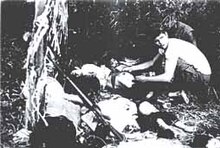
The ROK Capital letter Partition reportedly perpetrated the Bình An/Tây Vinh massacre in February/March 1966. The 2d Marine Brigade reportedly perpetrated the Binh Tai Massacre on 9 October 1966.[47] In Dec 1966, the Blue Dragon Brigade reportedly perpetrated the Bình Hòa massacre.[48] The Second Marine Brigade perpetrated the Phong Nhị and Phong Nhất massacre on 12 Feb 1968.[49] [50] S Korean Marines reportedly perpetrated the Hà My massacre on 25 February 1968.[51] Co-ordinate to a study conducted in 1968 by a Quaker-funded Vietnamese-speaking American couple, Diane and Michael Jones, in that location were at least 12 mass killings committed by Due south Korean forces that approached the scale of the My Lai Massacre, with reports of thousands of routine murders of civilians, primarily the elderly, women and children.[52] [53] A split study was carried out past RAND Corporation employee Terry Rambo, who conducted interviews in 1970 on reported Korean atrocities in ARVN/civilian areas.[54] Widespread reports of deliberate mass killings by Korean forces alleged that they were the result of systemic, deliberate policies to massacre civilians, with murders running into the hundreds.[54] These policies were too reported on past United states commanders, with 1 US Marine General stating "whenever the Korean marines received burn down "or recall [they got] fired on from a hamlet ... they'd divert from their march and go over and completely level the village ... it would be a lesson to (the Vietnamese)."[55] Some other Marine commander, Gen. Robert E. Cushman Jr., added, "we had a big problem with atrocities attributed to them, which I sent on downward to Saigon."[55] Investigations by Korean civic groups take alleged that at least 9,000 civilians were massacred by ROK forces.[56]
Army of the Commonwealth of Vietnam [edit]
The ARVN suffered 254,256 recorded gainsay deaths betwixt 1960 and 1974, with the highest number of recorded deaths existence in 1972, with 39,587 gainsay deaths.[57] According to Guenter Lewy, the ARVN suffered between 171,331 and 220,357 deaths during the war.[12] [24] : 106 R.J. Rummel estimated that ARVN suffered between 219,000 and 313,000 deaths during the war, including in 1975 and prior to 1960.[20]
| Yr | 1960 | 1961 | 1962 | 1963 | 1961 | 1965 | 1966 | 1967 | 1968 | 1969 | 1970 | 1971 | 1972 | 1973 | 1974 | Total (1960–1974) |
|---|---|---|---|---|---|---|---|---|---|---|---|---|---|---|---|---|
| ARVN gainsay deaths[57] | 2,223 | 4,004 | 4,457 | 5,665 | 7,457 | 11,242 | 11,953 | 12,716 | 27,915 | 21,833 | 23,346 | 22,738 | 39,587 | 27,901 | 31,219 | 254,256 |
Other casualties for the ARVN included up to ane,170,000 military wounded,[58] and 1,000,000 surrendered or captured.[59]Prior to the 1975 spring offensive, at to the lowest degree 5,336 ARVN were captured, being released in the aftermath of the Paris Peace Accords. [threescore]
North Vietnamese and Viet Cong military casualties [edit]
Deaths
According to the Vietnamese authorities'due south national survey and assessment of war casualties (March 2017), there were 849,018 PAVN/VC military personnel expressionless, including gainsay expiry and non-combat death, from the menstruation between 1955 and 1975.[61] Based on unit surveys, a rough judge of 30–twoscore% of expressionless and missing were non-gainsay deaths.[61] Beyond all iii wars including the First Indochina War and the 3rd Indochina War there was a total of 1,146,250 PAVN/VC military machine deaths or missing, included 939,460 deaths (their bodies were found) and 207,000 missing (their bodies were not found). Per war: 191,605 deaths/missing in the First Indochina War, 849,018 deaths/missing in the Second Indochina War (Vietnam War), and 105,627 deaths/missing in the 3rd Indochina War.[61] Information technology is unclear how the Vietnamese Government figures correlate to other reports of 300–330,000 PAVN/VC missing-in-activeness from the Vietnam War.[62] Per the official history, ane of the deadliest years was 1972, in which the PAVN suffered over 100,000 casualties.[63] After the U.Southward.'s withdrawal from the conflict, the Pentagon estimated PAVN deaths at 39,000 in 1973 and 61,000 in 1974.[64]
At that place has been considerable controversy about the exact numbers of deaths inflicted on the Communist side by U.S. and allied South Vietnamese forces. Shelby Stanton, writing in The Rise and Autumn of an American Regular army, declined to include casualty statistics because of their 'general unreliability.' Accurate assessments of NV Ground forces and Viet Cong losses, he wrote, were 'largely impossible due to lack of disclosure past the Vietnamese authorities, terrain, destruction of remains past firepower, and [inability] to confirm artillery and aerial kills.' The 'shameful gamesmanship' practiced by 'certain reporting elements' under force per unit area to 'produce results' likewise shrouded the process.[65]
RJ Rummel estimates 1,011,000 PAVN/VC combatant deaths.[66] The official US Department of Defence force figure was 950,765 communist forces killed in Vietnam from 1965 to 1974. Defense Department officials believed that these trunk count figures need to be deflated by 30 percent. For this figure, Guenter Lewy assumes that 1-third of the reported enemy killed may have been civilians, last that the actual number of deaths of the VC and PAVN military machine forces was probably closer to 444,000.[12]
Writer Mark Woodruff noted that when the Vietnamese Government finally revealed its estimated losses (in April 1995) as being i.1 million dead, US body count figures had really underestimated enemy losses.[67]
The Phoenix Program, a counterinsurgency plan executed by the Us Central Intelligence Agency (CIA), United States special operations forces, and the Republic of Vietnam's security apparatus, killed 26,369 suspected of being VC operatives and informants.[68] [69]
Historian Christian Appy states "search and destroy was the principal tactic; and the enemy trunk count was the primary mensurate of progress" in the United states of america strategy of attrition. Search and destroy was a term to describe operations aimed at flushing the Viet Cong out of hiding, while body count was the measuring stick for performance success and this resulted in exaggeration and list civilian deaths as enemy KIA. One report estimated that American commanders exaggerated body counts by 100 percent.[70]
Other casualties
The NVA/VC forces suffered around 600,000 wounded during the war,[71] and prior to the 1975 bound offensive, lost at least 26,880 soldiers taken prisoner - beingness released after the 1973 Peace Accords.[72] Additionally, they besides lost up to 101,511 personnel as defectors due to the Chieu Hoi program.[73]
U.s. war machine [edit]

Casualties as of 4 May 2021:
- 58,281 KIA or non-combat deaths (including the missing and deaths in captivity)[74]
- 153,372 WIA (excluding 150,332 persons non requiring infirmary intendance)[75]
- 1,584 MIA (originally 2,646)[a] [78]
- 766–778 Prisoner of war (652–662 freed/escaped,[b] [fourscore] [81] 114–116 died in captivity)[80] [82]
The total number of American personnel who were KIA or died non-hostile deaths, were enlisted personnel with a casualty number of l,441. The full number of officer casualties, deputed and warrant, are 7,877. The following is a nautical chart of all casualties, listed by race, and in descending order. [83]
| White | Blackness | Hispanic | Hawaiian/Pacific Islander | American Indian/ Alaska Native | Non-Hispanic (other race) | Asian |
|---|---|---|---|---|---|---|
| 49,830 | 7,243 | 349 | 229 | 226 | 204 | 139 |
The total number of casualties, both KIA and non-hostile deaths, for drafted and volunteer service personnel (figures are approximated):[84]
| Volunteer | Draftees |
|---|---|
| 70% | 30% |
During the Vietnam War, xxx% of wounded service members died of their wounds.[85] xxx–35% of American deaths in the state of war were not-combat or friendly burn down deaths; the largest causes of death in the U.Southward. military machine were small arms fire (31.eight%), booby traps including mines and frags (27.4%), and aircraft crashes (14.7%).[86]
Asymmetry of African American casualties [edit]
African Americans suffered disproportionately high casualty rates in Vietnam. In 1965 alone they comprised xiv.1% of total combat deaths, when they only comprised approximately 11% of the total U.S. population in the same twelvemonth.[87] [88] With the draft increasing due to the troop buildup in South Vietnam, the armed forces significantly lowered its access standards. In October 1966, Defense force Secretarial assistant Robert McNamara initiated Project 100,000 which further lowered armed services standards for 100,000 boosted draftees per year. McNamara claimed this program would provide valuable preparation, skills and opportunity to America'south poor—a hope that was never carried out. Many black men who had previously been ineligible could now exist drafted, forth with many poor and racially intolerant white men from the southern states. This led to increased racial tension in the armed forces.[89] [90]
The number of United states military personnel in Vietnam jumped from 23,300 in 1965 to 465,600 by the end of 1967. Between Oct 1966 and June 1969, 246,000 soldiers were recruited through Projection 100,000, of whom 41% were Black; Blackness people only made up virtually 11% of the population of the US.[89] Of the 27 meg draft-age men between 1964 and 1973, 40% were drafted into armed forces service, and simply 10% were actually sent to Vietnam. This group was made up most entirely of either working-class or rural youth.[ citation needed ] Black people often made upwards a disproportionate 25% or more of combat units, while constituting only 12% of the military. twenty% of Black males were combat soldiers, sailors, airmen and marines.[87] [91]
Civil rights leaders, including Martin Luther Male monarch Jr., Malcolm X, John Lewis, Muhammad Ali and others, criticized the racial disparity in both casualties and representation in the entire military, prompting the Pentagon to order cutbacks in the number of African Americans in combat positions. Commander George L. Jackson said, "In response to this criticism, the Department of Defense took steps to readjust force levels in society to achieve an equitable proportion and employment of Negroes in Vietnam." The Army instigated myriad reforms, addressed issues of discrimination and prejudice from the post exchanges to the lack of black officers, and introduced "Mandatory Sentinel And Activity Committees" into each unit. This resulted in a dramatic decrease in the proportion of blackness casualties, and by late 1967, black casualties had fallen to 13%, and were beneath x% in 1970 to 1972.[89] [92] As a result, by the war's completion, total black casualties averaged 12.5% of Usa combat deaths, approximately equal to percentage of draft-eligible black men, though nevertheless slightly higher than the 10% who served in the war machine.[92]
Aftermath [edit]
Unexploded ordnance proceed to detonate and impale people today. Co-ordinate to the Vietnamese authorities, unexploded ordnance has killed some 42,000 people since the end of the war. Co-ordinate to a 2009 written report, i third of land in the central provinces of Vietnam is notwithstanding contaminated with unexploded mines and ordnance.[93] [94] In 2012 alone, unexploded ordnance and claimed 500 casualties in Vietnam, Lao people's democratic republic and Kingdom of cambodia, according to activists and Vietnamese government databases. The United States has spent over $65 million since 1998 as role of unexploded ordnance clearing operations.[95]
Agent Orange and like chemical defoliants have also acquired a considerable number of deaths and injuries over the years, including among the US Air Strength coiffure that handled them. The government of Vietnam says that 4 1000000 of its citizens were exposed to Agent Orange, and every bit many as 3 million have suffered illnesses because of it; these figures include the children of people who were exposed.[96] The Red Cross of Vietnam estimates that upwardly to ane 1000000 people are disabled or endure health problems due to Amanuensis Orange exposure.[97]
On 9 August 2012, the U.s.a. and Vietnam began a cooperative cleaning up of the toxic chemical from part of Da Nang International Drome, mark the first time Washington has been involved in cleaning upwards Agent Orange in Vietnam. Da Nang was the main storage site of the chemical. Two other cleanup sites being reviewed by the United States and Vietnam are Biên Hòa Air Base, in the southern province of Đồng Nai—a 'hotspot' for dioxin—and Phù Cát Air Base in Bình Định Province, according to U.S. Administrator to Vietnam David Shear. The Vietnamese newspaper Nhân Dân reported in 2012 that the U.S. regime was providing $41 million to the project, which aimed to reduce the contamination level in 73,000 g³ of soil by late 2016.[98]
Following the end of the State of war, many refugees fled Vietnam by boat and transport. The number of boat people leaving Vietnam and arriving safely in another country totalled about 800,000 between 1975 and 1995. Many of the refugees failed to survive the passage, facing danger from pirates, over-crowded boats, and storms. Co-ordinate to the United Nations High Committee for Refugees, betwixt 200,000 and 400,000 boat people died at sea. The boat people's first destinations were the Southeast Asian locations of Hong Kong, Republic of indonesia, Malaysia, the Philippines, Singapore, and Thailand. From refugee camps in Southeast Asia, the great bulk of boat people were resettled in more developed countries. Pregnant numbers resettled in the Us, Canada, Italy, Australia, French republic, West Germany, and the Britain.[99]
Other nations' casualties [edit]
Cambodian Civil War
- 275,000–310,000 killed[100] [101] [102]
Laotian Civil War
- 20,000–62,000 killed[5]
Military [edit]
South Korea
- 5,099 Killed in activity
- xiv,232 wounded
- 4 missing in activeness[103]
Australia
- 426 killed in activity, 74 died of other causes[104]
- 3,129 wounded[104]
- 6 missing in action (all accounted for and repatriated)[105]
Thailand
- 351 killed in action[103] [106]
- ane,358 wounded
New Zealand
- 37 killed in activity plus 2 civilians[107] [108]
- 187 wounded
Philippines
- 9 killed in action[109]
- 64 wounded[109]
Republic of China (Taiwan)
- 25 killed in activity[110]
- 17 captured [111]
People's Republic of Red china
- 1,446 killed in activity[112]
Soviet Union
- ~16[113]
United kingdom of great britain and northern ireland
- ~ane[ citation needed ]
Notes [edit]
- ^ Including 28 civilians, originally at that place were 52 missing civilians.[76] [77]
- ^ One escapee died of wounds sustained during his rescue fifteen days subsequently.[79]
References [edit]
- ^ Turse 2013, p. 12 harvnb error: no target: CITEREFTurse2013 (help).
- ^ Lewy, Guenter (1978), America in Vietnam, New York: Oxford University Printing, pp. 447
- ^ Lewy, Guenter (1978), America in Vietnam, New York: Oxford University Press, pp. 442–453
- ^ a b Charles Hirschman et al., Vietnamese Casualties During the American State of war: A New Estimate, Population and Development Review, December 1995.
- ^ a b c d Obermeyer, Ziad; Murray, Christopher J. L.; Gakidou, Emmanuela (2008). "Fifty years of violent state of war deaths from Vietnam to Bosnia: analysis of data from the world wellness survey plan". BMJ. 336 (7659): 1482–86. doi:10.1136/bmj.a137. PMC2440905. PMID 18566045. See Table 3 for most estimates.
- ^ Shenon, Philip, "20 Years Later on Victory, Vietnamese Communists Ponder How to Celebrate", The New York Times, 23 Apr 1995
- ^ "UCDP/Prio Armed Conflict Database", Uppsala University, http://www.pcr.uu.se/enquiry/ucdp/datasets/ucdp_prio_armed_conflict_dataset/ Archived 2015-08-11 at the Wayback Machine, accessed 24 Nov 2014
- ^ a b Rummel, R. J. "Statistics of Vietnamese Democide", Lines 777–785, http://www.hawaii.edu/powerkills/SOD.TAB6.1B.GIF, accessed 24 Nov 2014
- ^ Rummel, 1997, line 61
- ^ Rummel, 1997, line 117
- ^ https://www.hawaii.edu/powerkills/DBG.TAB9.ane.GIF, accessed 24 November 2014
- ^ a b c Lewy, Guenter (1978). America in Vietnam. New York: Oxford Academy Press. Appendix i, pp. 450–53
- ^ Thayer, Thomas C (1985). State of war Without Fronts: The American Experience in Vietnam. Bedrock: Westview Press. Ch. 12.
- ^ Wiesner, Louis A. (1988). Victims and Survivors Displaced Persons and Other State of war Victims in Viet-Nam. New York: Greenwood Printing. p. 310
- ^ a b Bellamy, Alex J. (2017). Eastward Asia's Other Miracle: Explaining the Pass up of Mass Atrocities. Oxford University Printing. pp. 33–34. ISBN978-0191083785.
- ^ Willbanks, James H. (2008). The Tet Offensive: A Curtailed History. New York: Columbia University Printing. p. 32. ISBN978-0-231-12841-4.
- ^ Rand Corporation [http://www.dtic.mil/dtic/tr/fulltext/u2/a032189.pdf Some Impressions of Viet Cong Vulnerabilities an Interim Report 1965
- ^ James J. F. Forest Countering Terrorism and Insurgency in the 21st Century 2007 ISBN 978-0275990343
- ^ Walter Russell Mead (2013). Special Providence: American Foreign Policy and How It Changed the Globe. Routledge. pp. 219–. ISBN978-1-136-75867-six.
- ^ a b "Rummel 1997".
- ^ Michael Lee Lanning and Dan Cragg, Inside the VC and the NVA, (Ballantine Books, 1993), pp. 186–88
- ^ Rummel 1997, Lines 457 & 459. sfn error: no target: CITEREFRummel1997 (help)
- ^ Lewy, Guentner (1978), America in Vietnam New York: Oxford Academy Printing., pp. 272–73, 448–49.
- ^ a b Thayer, Thomas (1985). War without Fronts: The American experience in Vietnam. Westview Press. p. 51. ISBN978-1612519128.
- ^ Rummel 1997 Lines 521, 540, 556, 563, 566, 569, 575
- ^ a b Valentino, Benjamin (2005). Final Solutions: Mass Killing and Genocide in the 20th Century. Cornell University Press. p. 84. ISBN978-0801472732.
- ^ a b Miller, Edward (2017-12-29). "Opinion | Behind the Phoenix Plan". The New York Times. ISSN 0362-4331. Retrieved 2018-06-03 .
- ^ Rummel 1997 Lines 613]
- ^ Tucker, Spencer, ed. (2011). Encyclopedia of the Vietnam War: A Political, Social, and Military History. Volume Two. Santa Barbara, CA, p. 176
- ^ "Battlefield:Vietnam Timeline". Pbs.org. Retrieved 31 October 2011.
- ^ Kiernan, Ben; Owen, Taylor. "Bombs over Cambodia" (PDF). The Walrus (October 2006): 62–69. "Previously, it was estimated that between fifty,000 and 150,000 Cambodian civilians were killed past the bombing. "Given the fivefold increase in tonnage revealed past the database, the number of casualties is surely higher." Kiernan and Owen later revised their estimate of 2.vii million tons of U.S. bombs dropped on Cambodia down to the previously accepted figure of roughly 500,000 tons: See Kiernan, Ben; Owen, Taylor (2015-04-26). "Making More Enemies than We Impale? Calculating U.S. Bomb Tonnages Dropped on Laos and Kingdom of cambodia, and Weighing Their Implications". The Asia–Pacific Journal . Retrieved 2017-07-18 .
- ^ Agent orangish victims day, Tuoitre news 2013/08/11
- ^ History.com Operation Ranch Paw and Agent Orangish Retrieved 25/09/12
- ^ "Confusion" entry in Tucker, Spencer C., ed. (2011). The Encyclopedia of the Vietnam State of war (2nd ed.). ABC-CLIO. ISBN978-1-85109-961-0.
- ^ a b c "What if America 'Won' the Vietnam State of war?". whatifhub.com. whatifhub.
- ^ a b c Appy, Christian (1993). Working-Grade State of war: American Gainsay Soldiers and Vietnam (PDF). UNC Chapel Hill. p. 273.
- ^ "Body Count in Vietnam | HistoryNet". world wide web.historynet.com. 22 February 2018. Retrieved 2018-06-04 .
- ^ "Body Count in Vietnam | HistoryNet". www.historynet.com. 22 February 2018. Retrieved 2018-06-03 .
- ^ http://ls-tlss.ucl.ac.uk/course-materials/POLS6016_65225
- ^ "'Anything That Moves': Civilians And The Vietnam War". www.wbur.org . Retrieved 2018-06-03 .
- ^ Valentine, Tom. "Free Fire Zone".
- ^ Greiner, Bernd (2010). War Without Fronts: The USA in Vietnam. Yale University Press. ISBN978-0300168044.
- ^ Story of Tiger Force atrocities had to be told, Toledo Blade.
- ^ a b Turse 2013, p. 251 harvnb error: no target: CITEREFTurse2013 (assist).
- ^ Turse 2013, p. 212 harvnb error: no target: CITEREFTurse2013 (assistance).
- ^ Kim Chang-seok (2000-11-fifteen). 편견인가, 꿰뚫어 본 것인가 미군 정치고문 제임스 맥의 보고서 "쿠앙남성 주둔 한국군은 무능·부패·잔혹". Hankyoreh (in Korean). Retrieved 2012-10-fourteen .
- ^ Armstrong, Charles (2001). "America'due south Korea, Korea's Vietnam". Critical Asian Studies. Routledge. 33 (4): 530. doi:ten.1080/146727101760107415. S2CID 144205767.
- ^ "On War extra – Vietnam'southward massacre survivors". Al Jazeera. 2009-01-04. Archived from the original on 2021-12-12. Retrieved 2012-10-fourteen .
- ^ Go Gyeong-tae (2001-04-24). 특집 "그날의 주검을 어찌 잊으랴" 베트남전 종전 26돌, 퐁니·퐁넛촌의 참화를 전하는 사진을 들고 현장에 가다. Hankyoreh (in Korean). Retrieved 2012-10-fourteen .
- ^ 여기 한 충격적인 보고서가 있다 미국이 기록한 한국군의 베트남 학살 보고서 발견. Ohmynews (in Korean). 2000-eleven-xiv. Retrieved 2012-10-14 .
- ^ Kwon, Heonik (2006). Later the massacre: commemoration and consolation in Ha My and My Lai. University of California Press. p. 2. ISBN978-0520247970.
- ^ Chomsky, Noam; Herman, Edward Southward. (1973). Counter-Revolutionary Violence: Bloodbaths in Fact & Propaganda. Warner Modular Publications.
- ^ Journal, The Asia Pacific. "Anatomy of U.s. and South Korean Massacres in the Vietnamese Year of the Monkey, 1968 | Japan Focus". apjjf.org . Retrieved 2018-05-12 .
- ^ a b Times, Robert K. Smith Special to The New York (Jan 10, 1970). "VIETNAM KILLINGS LAID TO KOREANS (Published 1970)" – via NYTimes.com.
- ^ a b Griffiths, James. "The 'forgotten' My Lai: S Korea'southward Vietnam War massacres". CNN . Retrieved 2018-05-27 .
- ^ "Citizens' court to investigate Vietnam War atrocities committed past Southward Korean troops". Retrieved 2018-06-03 .
- ^ a b Clarke, Jeffrey J. (1988), Usa Army in Vietnam: Advice and Back up: The Concluding Years, 1965–1973, Washington, D.C: Heart of Military History, United States Regular army, p. 275
- ^ Tucker, Spencer C (2011). The Encyclopedia of the Vietnam War: A Political, Social, and Military History. ABC-CLIO. ISBN 978-1-85109-960-3
- ^ "The Fall of South Vietnam" (PDF). Rand Corporation.
{{cite web}}: CS1 maint: url-status (link) - ^ "Vietnamese Complete P.O.W Commutation". The New York Times. 9 March 1974.
{{cite spider web}}: CS1 maint: url-status (link) - ^ a b c "Chuyên đề 4 CÔNG TÁC TÌM KIẾM, QUY TẬP HÀI CỐT LIỆT SĨ TỪ NAY ĐẾN NĂM 2020 VÀ NHỮNG NĂM TIẾP THEO, datafile.chinhsachquandoi.gov.vn/Quản%20lý%20chỉ%20đạo/Chuyên%20đề%204.md".
- ^ Joseph Babcock (26 April 2019). "Lost Souls: The Search for Vietnam'south 300,000 or More MIAs". The Daily Beast. Retrieved 7 May 2019.
- ^ Whitcomb, Col Darrel (Summertime 2003). "Victory in Vietnam: The Official History of the People'due south Army of Vietnam, 1954–1975 (book review)". Air & Space Power Journal. Archived from the original on 2009-02-07.
- ^ Marilyn Young. "The Vietnam Wars." Harper Perennial; September 1991. Affiliate fourteen: "The "finish-fire war" claimed 26,500 ARVN dead in 1973, and nigh xxx,000 in 1974. Pentagon statistics listed 39,000 and 61,000 PRG/DRV dead for the same fourth dimension menses."
- ^ Shelby Fifty. Stanton, 'The Rise and Autumn of an American Army,' Spa Books, 1989, xvi.
- ^ Rummel 1997, Line 102. sfn error: no target: CITEREFRummel1997 (help)
- ^ Woodruff, Marker (1999). Unheralded Victory: Who won the Vietnam war?. Harper Collins. p. 211. ISBN978-0004725192.
- ^ McCoy, Alfred W. (2006). A question of torture: CIA interrogation, from the Cold War to the State of war on Terror. Macmillan. p. 68. ISBN978-0-8050-8041-4.
- ^ Harbury, Jennifer (2005). Truth, torture, and the American fashion: the history and consequences of U.S. interest in torture . Beacon Press. p. 97. ISBN978-0-8070-0307-7.
- ^ Appy, Christian G. (2000). Working-Class War: American Combat Soldiers and Vietnam. Univ of North Carolina Press. pp. 153–56.
- ^ Hastings, Max (2018). Vietnam an ballsy tragedy, 1945–1975. Harper Collins. ISBN 978-0-06-240567-8.
- ^ "Vietnamese Consummate P.O.Due west Substitution". The New York Times. 9 March 1974.
- ^ "Casualties - US vs NVA/VC".
{{cite web}}: CS1 maint: url-status (link) - ^ Vietnam Veterans Memorial Fund (4 May 2021). "2021 Name ADDITIONS AND STATUS CHANGES ON THE VIETNAM VETERANS MEMORIAL" (Press release).
- ^ "Usa Military machine Operations: Casualty Breakdown". www.globalsecurity.org.
- ^ "Defense POW/MIA Accounting Agency Vietnam (PMSEA) Report for Noncombatant (Unaccounted For)" (PDF). xiv October 2020.
- ^ "Capture Defense force Pow/MIA Accounting Agency Vietnam (PMSEA) Report for Civilian (Accounted For – Identified Since 1973)" (PDF). 14 October 2020.
- ^ "Vietnam-era unaccounted for statistical study" (PDF). 1 March 2021.
- ^ "Vietnam Prisoners of War – Escapes and Attempts" (PDF).
- ^ a b "Vietnam War Statistics".
- ^ [one] [2]
- ^ "Vietnam War Casualties (1955-1975)". world wide web.militaryfactory.com.
- ^ "Vietnam State of war U.Due south. Military Fatal Casualty Statistics". National Athenaeum. August 15, 2016.
- ^ "Vietnam State of war Facts, Stats and Myths". US Wings.
- ^ Scott McGaugh (16 September 2012). "Learning from America'due south Wars, Past and Present U.S. Battlefield Medicine Has Come a Long Way, from Antietam to Republic of iraq". San Diego Marriage Tribune. Archived from the original on 27 July 2014. Retrieved 22 February 2013.
- ^ The American War Library. Vietnam War Casualties and Cause. Data compiled past William F. Abbott from figures obtained soon after the construction of the Vietnam State of war Memorial.
- ^ a b Fighting on Ii Fronts: African Americans and the Vietnam War; Westheider, James Eastward.; New York University Press; 1997; pp. eleven–16
- ^ "African-Americans In Combat | History Detectives | PBS". www.pbs.org.
- ^ a b c War within war; The Guardian; September 14, 2001; James Maycock
- ^ Working-Class War: American Combat Soldiers & Vietnam; Appy, Christian; University of North Carolina Press; 2003; pp. 31–33
- ^ "International Socialist Review". isreview.org.
- ^ a b Appy, Christian G. (November 9, 2000). Working-Course State of war: American Combat Soldiers and Vietnam. Univ of Northward Carolina Printing. ISBN9780807860113 – via Google Books.
- ^ "Vietnam War Bomb Explodes Killing Iv Children". Huffington Post. three December 2012.
- ^ Vietnam: Report Details Unexploded Ordnance The New York Times (July 31, 2009)
- ^ "Vietnam War Bombs Nevertheless Killing People forty Years Later". The Huffington Post. 2013-08-14.
- ^ Ben Stocking for AP, published in the Seattle Times May 22, 2010 [seattletimes.com/html/health/2011928849_apasvietnamusagentorange.html Vietnam, Usa still in conflict over Agent Orangish]
- ^ Jessica King (2012-08-x). "U.S. in first effort to clean upwards Agent Orange in Vietnam". CNN. Retrieved 2012-08-11 .
- ^ "U.S. starts its beginning Amanuensis Orange cleanup in Vietnam". Reuters. August ix, 2012.
- ^ Associated Press, June 23, 1979, San Diego Wedlock, July twenty, 1986. See generally Nghia M. Vo, The Vietnamese Boat People (2006), 1954 and 1975-1992, McFarland.
- ^ Heuveline, Patrick (2001). "The Demographic Analysis of Mortality Crises: The Instance of Cambodia, 1970–1979". Forced Migration and Mortality. National Academies Press. pp. 103–04. ISBN978-0309073349.
Subsequent reevaluations of the demographic data situated the expiry price for the [civil war] in the order of 300,000 or less.
- ^ Banister, Judith; Johnson, East. Paige (1993). "After the Nightmare: The Population of Cambodia". Genocide and Democracy in Kingdom of cambodia: The Central khmer Rouge, the United Nations and the International Customs. Yale University Southeast Asia Studies. p. 87. ISBN978-0938692492.
An estimated 275,000 excess deaths. We have modeled the highest bloodshed that we can justify for the early 1970s.
- ^ Sliwinski, Marek (1995). Le Génocide Khmer Rouge: Une Analyse Démographique. Paris: 50'Harmattan. pp. 42–43, 48. ISBN978-ii-738-43525-five. Of 310,000 estimated Cambodian Civil War deaths, Sliwinski attributes 46.3% to firearms, 31.seven% to assassinations (a tactic primarily used past the Khmer Rouge), 17.one% to (mainly U.Due south.) bombing, and 4.9% to accidents.
- ^ a b "KOREA military army official statistics, AUG 28, 2005" (PDF). Archived from the original (PDF) on July 22, 2011.
- ^ a b "Vietnam War, 1962–72 – Statistics". Australian War Memorial. 2003. Retrieved 2008-02-04 .
- ^ "Australian servicemen listed equally missing in action in Vietnam". Australian War Memorial. Retrieved 14 Feb 2015.
- ^ The Encyclopedia of the Vietnam War: A Political, Social, and Military machine History By Spencer C. Tucker "https://books.google.com/books?id=qh5lffww-KsC&lpg=PA53&dq=the%20encyclopedia%20of%20the%20vietnam%20war%20page%2064&pg=PA176&output=embed"
- ^ "New Zealand Rolls Of Honour – Past Disharmonize". Freepages.genealogy.rootsweb.ancestry.com. Retrieved 2012-09-25 .
- ^ "Overview of the state of war in Vietnam | VietnamWar.govt.nz, New Zealand and the Vietnam State of war". Vietnamwar.govt.nz. 1965-07-16. Archived from the original on 2013-07-26. Retrieved 2012-09-25 .
- ^ a b "Asian Allies in Viet-Nam" (PDF).
- ^ "America Wasn't the only Foreign Power in the Vietnam War". 2013.
{{cite spider web}}: CS1 maint: url-status (link) - ^ "Vietnam Reds to hold 17 From Taiwan every bit Spies". The New York Times. July 13, 1964.
- ^ Womack, Brantly (2006). China and Vietnam: The Politics of Asymmetry. Cambridge University Press. ISBN978-0521618342.
- ^ James F. Dunnigan; Albert A. Nofi (2000). Dirty Little Secrets of the Vietnam War: Military Information Y'all're Non Supposed to Know. Macmillan. ISBN978-0-312-25282-3.
External links [edit]
- National Archives AAD Searchable database.
- The Vietnam Middle and Annal. Texas Tech University.
- Vietnamese Casualties During the American war
Source: https://en.wikipedia.org/wiki/Vietnam_War_casualties
0 Response to "Groom and Family Members Die in Vietnam Crash"
Post a Comment